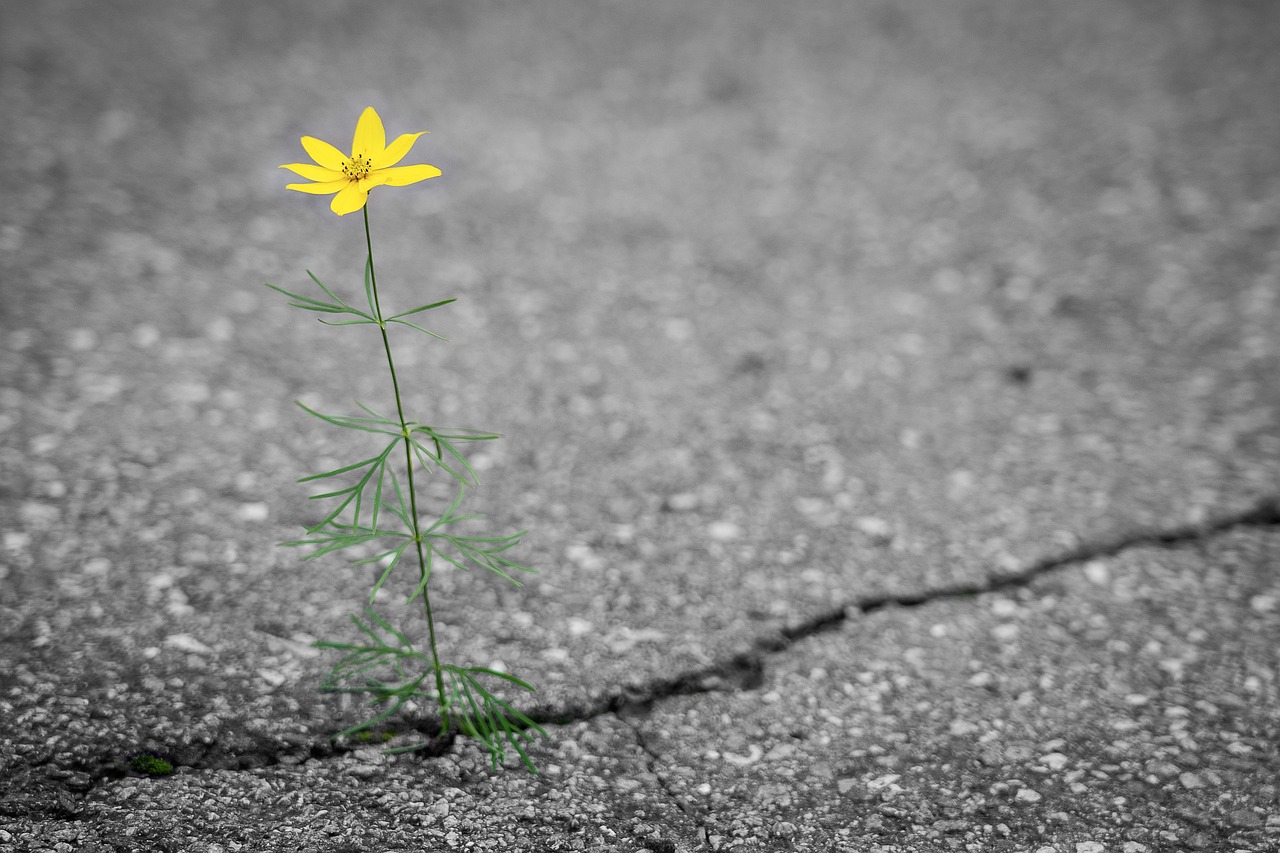
Sooner or later, everyone feels the crack in their own being. Through it, they are able to hear the call that emanates from their complete, true individuality.
‘There is a crack in everything, that`s how the light get`s in.’
Leonard Cohen.
Anyone researching the topic of ‘courage’ may come across the American psychologist and author Dr David R. Hawkins. In 1995, he published the concept of a scale of consciousness that assigns different states of consciousness and emotions to a sequence of levels from 0 to 1000. He gives ‚courage’ a very special status: that of the turning point in the development of consciousness. Hawkins considers this ‘calibration’ to be universally valid. As Hawkins explains, these gradations have been confirmed in countless kinesiological muscle tests and can be verified at any time. One can speak of mental vibration states that can be read on the scale of human behaviour and states.
The following observations are initially based on Hawkins’ view. 0 represents death, and 1000 represents the highest level, enlightenment. For him, the lowest emotion is shame/self-rejection (20), followed by guilt (30), apathy/hopelessness (50), sadness (75), fear (100), desire/greed (125), anger (150) and pride (175). According to Hawkins, all states below the value of 200 are energy-sapping, restrictive and unhealthy. They weigh us down like sandbags on a hot-air balloon. People with these emotions are in a deficient state and may tend to draw energy from others.
Only at a value of 200 does the deficiency cease and the person enter a positive energy balance. This is the value of courage. For Hawkins, it is the turning point, the point at which the ‘balloon’ begins to rise. From this point on, emotional reactions are increasingly reduced. This is followed on the scale by neutrality (250), willingness (310), acceptance (350), reason (400), love (500), unconditional love/joy of existence (540), peace/inner silence (600) and enlightenment/divine consciousness (700-1000). It can be said that, from a certain level of consciousness onwards, the spiritual state of vibration can only be explained by a higher energy field, by participating in a ‘world of unconditional love and peace’.
It is also interesting that, according to Hawkins, each level of consciousness reflexively brings with it a certain self-image and image of God or a divine idea.
Courage (200) = I can rise above myself = God is behind me.
Pride (175) = I am better than others = I don’t need God.
Anger (150) = I have to fight against something or someone = God is unfair.
Desire (125) = I don’t have enough = God is withholding good from me, doesn’t want me to have it.
Fear (100) = I am in danger = God is punishing me.
Sadness (75) = I am losing something important to me = God is abandoning me.
Apathy (50) = There is no way out for me. It is hopeless = God condemns me.
Guilt (30) = I deserve punishment = God is unforgiving.
Shame (20) = I am not worthy of love = God despises me.
So much for the concept of consciousness developed by Dr Hawkins.
What can this mean for a person who is searching for inner fulfilment, for profound transformation?
The driving force, the linchpin of inner development, is courage. Courage is not an emotion in the true sense of the word. It is rather a quality related to the classical Greek concept of virtue: bravery.
If we take a closer look at courage, we can see that it is often not there when it is needed most. That is why the apocryphal Gospel of Mary says: ‘Take courage! And if you are now discouraged, take courage nonetheless!’
Courage is something that is often latent and can be consciously “revived”. Yes, it always involves overcoming something that we shy away from with a large part of our being.
But what are we retreating from, and where do we want to go? Why have courage?
If we think big at this point and disregard our everyday struggles, which of course also have their appropriate significance – what is it that we fear most and what requires the utmost courage?
The greatest fear we have (even if we are rarely aware of it) is probably the fear of death. It accompanies us for most of our lives. Are we afraid of not being, of no longer existing? Or, if we assume a transformation, are we afraid of what awaits us?
The greatest and deepest longing that lives within us (even if it usually remains unconscious) is the longing to reconnect with the divine, with divine unity. But, like death, we cannot comprehend what will really happen when this longing is fulfilled. Would it also be a state of no longer being? Or does a far-reaching transformation await us, in which our previous existence dissolves? The divine cannot be known. We cannot integrate it into our old system of perception and processing, just as a river cannot contain the sea.
It can only be the other way around: our ego consciousness must be integrated, must be known and processed by the divine spirit. The sea can easily absorb the river.
Krishnamurti said: ‘You are never afraid of the unknown; you are afraid of the end of the known.’
So deep down, we also feel a fear of what we long for as fulfilment. Will ‘we’ still exist then?
Only courage can carry us forward.
The courage to let go of the familiar, to let the unknown into our lives. We must let go of ourselves to enable a new stage of becoming.
Jesus said: ‘For whoever wants to save their life will lose it, but whoever loses their life for me will find it’ (Matthew 16:25).
How much of our lifetime are we preoccupied with emotions that limit and depress us? And the corresponding thought patterns, physical sensations and the accompanying, mostly unconscious negative self-images and images of God.
At the same time, there is always the possibility to give ourselves an inner push, to turn away from the closed world in which we are stuck and to face the open world, the ‘whole’ that means freedom and transformation. We therefore have a choice between two completely different states of heart.
As a rule, we live in a closed space of perception – a closed system that confirms itself. Our beliefs, experiences and thoughts circle in familiar patterns, reinforcing each other and creating an apparent certainty: this is how the world is. This is who I am.
Hawkins’ energy-sapping, enslaving levels of consciousness can be seen as smaller units, as interchangeable perception compartments within a perception space, each with its own plausible narrative. But precisely because of their painful and limiting nature, they can also be helpful. They can stimulate the longing for openness, so that we seek a way out – not just from a negative state of mind, but from our fundamental existential dilemma.
All these spaces are like a prison for our souls. They largely filter out the new, the foreign, the unknown. They protect, but they also constrain and hold us back. Closure preserves stability, but it prevents change.
This contrasts with the open – the risk of breaking away from habits, allowing new perspectives, enduring uncertainty, perceiving attachments as shackles. It is the step into the unknown that penetrates the old walls and opens up to the unlimited, whole life, to eternity.
Leonard Cohen expressed a profound truth about human existence in his hymn Anthem:
‘There is a crack in everything, that’s how the light gets in.’
Sooner or later, every person feels this crack within themselves – a fragility that is unsettling. It can be a loss, an inner turmoil, the sudden feeling that the life you are used to no longer holds you up.
The crack tears open uncertainties and shatters the plausibility of the closed system.
But Cohen shows that this is precisely where opportunity lies. Only when the old breaks down can something new shine through. The crack is not the end – it can be the beginning of a great development. Towards what we long for in the depths of our hearts. Towards what promises us real fulfilment, peace and vitality.
However, many of our efforts, both individual and collective, are aimed at using every trick and sophistication to patch up the cracks that appear, to make them invisible or to cover them up. Constant busyness, media distractions, addictions of all kinds, medication, belief in salvation from outside through technological progress, politicians or great heroes on the world stage, and perhaps even some therapies or esoteric practices fulfil this purpose more or less unconsciously. From a global perspective, the increase in control and surveillance plays a significant role here.
Especially in view of current world events, it is astonishing how large such cracks can become without the collective consciousness of humanity developing deeper insights and questioning the narratives and worldviews that have been handed down to us.
And now the question again: Why is courage needed in this context?
Surely, first and foremost, an awakened, yearning heart must have developed within the individual. And then a crack in one’s own familiar world has become visible, and it is impossible to ignore. Now an insight can develop that not just a small change or adjustment in one’s behaviour is necessary, but a profound reversal of one’s life. What has been is viewed in a completely new light and fundamentally questioned. The old concept of life no longer holds. The realisation arises that a new power must come into effect, one that goes beyond our own abilities and exceeds our possibilities. This requires the courage to admit our own structural inability and to develop the willingness to turn to a higher power. Ultimately, it is also a matter of being fundamentally prepared to submit to a higher order of being and to take our place in it.
It is humility.
It is the insight: ‘Without me you can do nothing’ (John 15:5).
This insight opens us up to faith. Faith here has nothing to do with believing in dogmas. Faith is the ability of human beings to connect with higher realms of development that they cannot grasp or comprehend by aligning their hearts. It requires an act of faith, the assumption of SOMETHING beyond our conscious mind, which is much more than we could ever be with our old nature. SOMETHING that receives and accepts us at any time, however and wherever we are. SOMETHING from which help and guidance emanate. This SOMETHING is NOTHING to us. And it takes courage to entrust ourselves completely to this NOTHING and let go of what we possess. Faith ignites the potential of God within us. Otherwise, there is nothing else to which we can turn our hearts. We begin to sense, and increasingly know with certainty, that the crack in our own world is a path to freedom, that behind it lies ‘true life’ and our ‘real self.’ The connection with the open space gives us new strength and new courage to take the next step. An ever-stronger longing arises for what wants to emerge from behind the crack.
It is the courage to believe.
The promise resounds: ‘Ask, and it will be given to you; seek, and you will find; knock, and it will be opened to you’ (Matthew 7:7).
Insight and faith are followed by action. Action is NOT following old ego strategies and patterns. It is a surrender of ego-consciousness to the broken reality as it is right now and a surrender to the flow of life, giving oneself away to the numinous, to the nameless unknown.
It is the radical acceptance of what is happening at this very moment. It is at the same time a trust and the concrete experience that this NOTHING is sustainable, that it gives us an unshakeable foothold. According to the world, this is not a noteworthy deed. In a spiritual sense, it is the greatest thing a human being can do. It is a complete and conscious acceptance of the rift in life. And much more: it becomes a connection, a becoming one with it – and with the light that shines through it. The rift can then change us profoundly and structurally. Through it, an effectiveness is set in motion that gradually reconnects us with our divine origin, with our spiritual and emotional home. The crack is now allowed to expand as part of a process and bring new light into the old world. Like John of Patmos, we see a new heaven and a new earth opening up. In the process, we become different. Yes, we become the person who is laid out in the depths of our hearts and who we were meant to be from the beginning.
It is the courage to act.
It is self-surrender: ‘He must increase, but I must decrease’ (John 3:30).
This process ultimately leads to the request rising from the heart:
‘Thy will be done!’
Courage is the turning point of our consciousness. We have not linked this reflection to the goal of climbing a series of points on the consciousness scale. We have opened up a broader panorama. This is about the turning point from a horizontal to a vertical orientation, from the closed to the open. It is about a profound rebellion against life, which we can carry out again and again at any moment, wherever we happen to be in terms of consciousness.
Of course, this shift from the closed to the open also affects our state of mind. Through the secure footing we are increasingly experiencing in the new reality of life, which is ‘not of this world,’ we can also surrender internally to emotions such as guilt, grief, fear and anger. We no longer resist them. Unconscious shadow aspects can thus reveal themselves and, with the help of the new forces of light, be integrated into our consciousness. In this way, they can lose their terror and gradually ‘swing out’. C.G. Jung’s concept of the individuation of the human being can thus find its spiritual realisation within us.
Every crack that becomes visible in our reality is a call from our complete true individuality to us. Like a bird that, when it is ready, breaks out of its protective shell by pecking it from the inside, every human being will, in time, develop the courage to follow their true destiny.