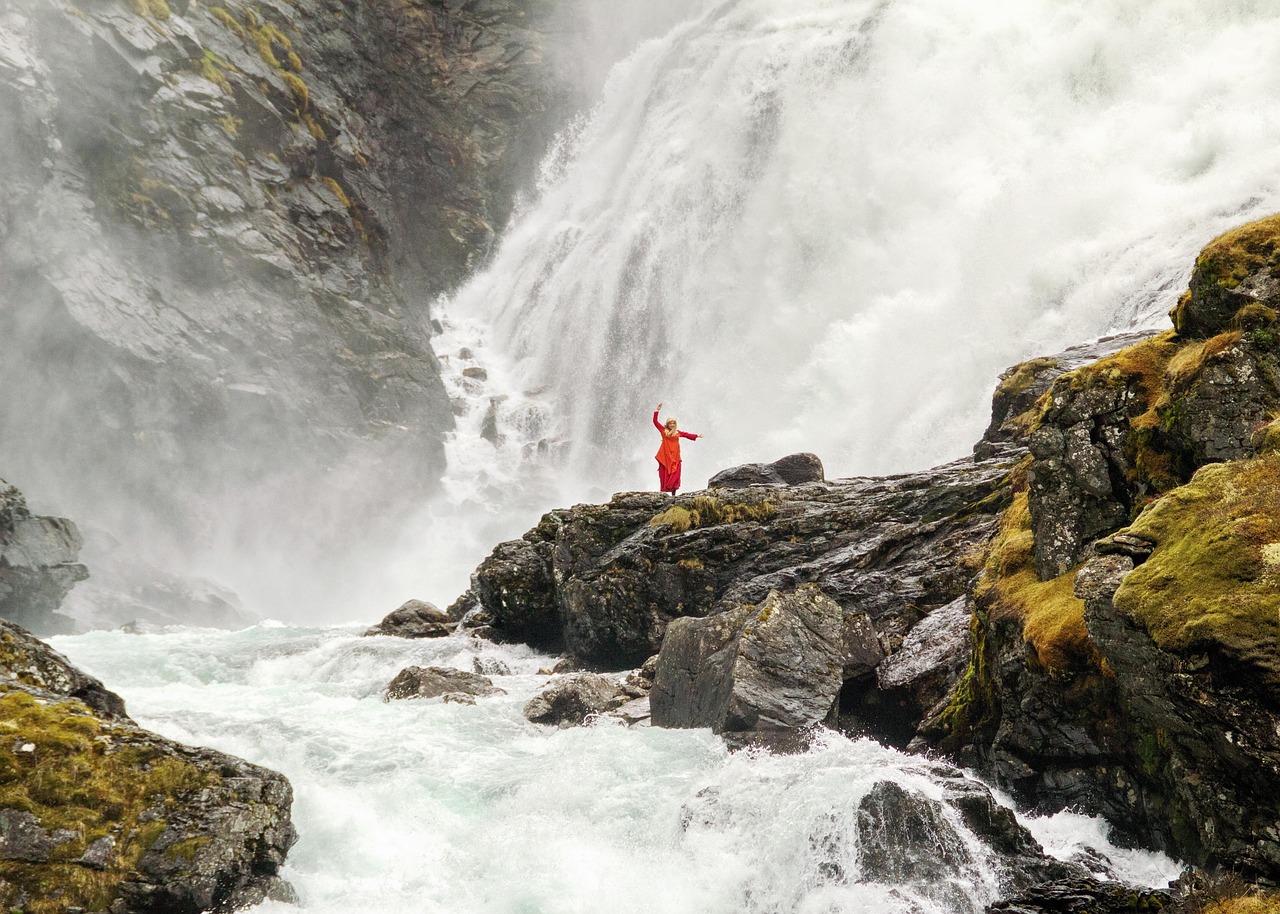
Mother GANGA calls all people with her high vibration. The creative force within them should also be awakened.
Mother GANGA shows us symbolically and lovingly that we too can bring the sacred flow of energies to fruition in our bodies, in our entire being, the interplay of Ida and Pingala, of male and female in its primal form, so that the new human being, two in one, can emerge within us.
What a powerful flow! Roaring, thundering, rushing, bubbling, gurgling, in waves crashing over each other, constantly forming new shapes! With tremendous primal power and a polyphonic sound, ‘Mother GANGA’, the sacred river of India, bursts forth from the so-called ‘cow’s mouth’ (Gaumukh), the source at an altitude of 4000 metres. The ‘cow’s mouth’ is located at the foot of a 26 km long glacier below the sacred mountain SHIVLING (6543 m) in the middle of the mighty Himalayan mountains. The GANGA water here is ice cold, with small ice floes floating on the surface. One imagines a spring to be bubbling or babbling, but here an immeasurable amount of water bursts out of the glacier gate. A real primal force pours out from the invisible into the visible at this sacred place of the Hindus.
Shivling, the sacred mountain of northern India in the region of Uttarakhand, the ‘land of the gods’ as it is called here, towers majestically over this impressive scene with its pyramidal white peak. I have the impression that this sacred mountain and the bubbling source of the GANGA below are living symbols of the origin of all creation. The millennia-old Indian creation myths of SHIVA and SHAKTI find a symbolic as well as concrete physical-geographical location here. Here one can vividly imagine Shiva sitting meditatively and motionless on the high mountain of Shivling, in spiritual elevation, in the primordial vibration of the divine. However, it takes a formative, creative ‘feminine’ divine power to bring everything into being. It is the Shakti power, usually in the form of the goddess PARVATI, but here in the form of the river goddess GANGA.[1]
The TAPOVAN plateau at 4480 m, at the foot of Shivling is slightly above the source of the GANGA: here, in both real and symbolic form, SPIRIT and MATTER, FIRE and WATER, the transcendent, formless divine and the immanent, revealed divine touch each other. ‘Shiva’ on Mount Shivling provides an unimaginably high background vibration from the unmanifest. It is a vibrancy that touches me and many visitors to the Tapovan plateau deeply, bringing tears to my eyes. The last time I experienced such a high (and always present) vibration was in the King’s Chamber of the Pyramid of Giza in Cairo.
The entire Tapovan plain and the source of the GANGA form together an immensely powerful field. Pilgrims from all over the world are drawn to this sacred meeting place and return regularly, year after year, to breathe in the high vibration and allow themselves to be transformed.
From this powerful background radiation, Mother GANGA brings everything into being in both symbolic and concrete physical form, creating an infinite diversity of forms in matter. Primordial masculine and feminine forces interact here: they create the elements of fire, earth, water and air, as well as the etheric space, the protoplasm, the minerals and stones, the plant world, the animals and the human beings.
Up here at an altitude of 4,500 metres, there is nothing solid, nothing permanent, no ‘statics’, nothing is motionless. Everything is in a state of constant transformation and change. Where there were icebergs yesterday, there are sand dunes today; where there were hills and mountains made of boulders yesterday, strong winds suddenly create sliding scree fields and avalanches of rock that can make for an extremely dangerous journey for hikers. I cannot help feeling that Shiva and Shakti, the two primal forces, are at work here in an interplay of creation, destruction and dissolution, immediately making room for a new creation to begin.
—
For several days now, I have been travelling from GANGOTRI, the holy pilgrimage town with its ancient white temple, along arduous paths towards the source of the GANGA. Gangotri (at an altitude of 3000 m) is a holy place, one of the four sacred sites of the CHARDHAM, the Hindu pilgrimage circuit to the four most important temples in the Himalayas (Jamunotri, Gangotri, Kedarnath, Badrinath).
Packed pilgrim buses wind their way up the serpentine road through the GANGA valley to the pilgrimage site of Gangotri, where the road ends abruptly. In the centre of Gangotri stands the white GANGA temple, surrounded by a magnificent mountain landscape. Here, thousands take a ritual bath in the holy GANGA. Early in the morning and in the evening, the AARTI ceremony is celebrated communally in and in front of the temple, worshipping fire and water, the creative forces of nature. Accompanied by sacred chants, lights such as oil or ghee lamps are waved in worship of the fire and the sacred GANGA river. In the villages of the Himalayas, women gather around the fire to sing KIRTAN together and worship Mother GANGA with sacred chants.
Even though the road ends in Gangotri, the pilgrimage trail continues further into the mountains. The narrow, rocky trail winds higher and higher through the river valley, past dangerous scree fields and breakneck precipices, right through the middle of torrential, ice-cold tributaries of the GANGA. I am constantly accompanied by the invigorating, roaring sound of the river water. Hundreds of pilgrims are with me on the trail. Rishis, Sadhus, Babas, some of them barefoot, who have set out on foot from Delhi, 600 km away, to reach the holy source of the GANGA, orange-robed monks, all magically drawn by the sacred primal force. No deprivation is too great for them, no difficulty on the way is an obstacle for them. They walk in the power of ‘Mother GANGA’, in the power of ‘Mother DURGA’ [2]. They greet every fellow traveller, every pilgrim, very warmly and worship the maternal primal power with their ‘HARE HARE GANGE – JAY MAA GANGE’. They feel the enveloping, protective, confidence-giving power of the primordial mother. They draw water from the source of the GANGA to bring this sacred essence to their families, their home temples, their village temples and the gods who watch over them. They call this essence ‘GANGA-JOEL’, which means sacred water.
At an altitude of 3,800 metres, my guide Bhojbasa and I reach a small tent settlement, a stopover on the way to the source of the GANGA. An adventurous cable car crosses the river here. Six to eight people at a time can fit into an open iron cage with their luggage and cross the GANGA suspended from a wire rope. A long queue has formed, with around 200 pilgrims waiting patiently in the sun to climb into the open cable car cabin. No one is annoyed, no one shows impatience. The wait is characterised by devotion and cheerful serenity on the banks of the roaring, ever-rushing GANGA.
When, fatally, one end of the cable becomes knotted and the fully occupied cable car comes to a halt in the middle of the raging river, a brave Indian climbs along the wire with his bare hands, across the roaring river, to the stuck cable car. There, to thunderous applause from those waiting below, he unties the rope and gets the cabin moving again. A breakneck stunt that puts his life in danger. ‘Mother GANGA’, say the Hindus, ‘is always present with her protective, enveloping power.’
In the queue for the cable car, I meet Bhupendra, an Indian man of about 45, and his slightly younger sister Madhu. Both are on a pilgrimage to the holy source of the Ganga with their families, including their grandmother and children. As we talk, it quickly becomes clear that they have a deep understanding of the interplay between male and female primal forces. They explain to me in detail how MOKSHA, complete liberation from the cycle of birth and death, can only be achieved through the harmonious interaction of masculine and feminine energy within us, through the interaction of IDA and PINGALA.[3] They describe the three paths to this fundamental liberation and write them down in my notebook:
- True Worship – True worship in love and devotion: BHAKTI YOGA
- True Work – True service, the true deed: KARMA YOGA
- True Knowledge and Wisdom – True knowledge and wisdom through meditation: GYAN YOGA.
Obviously, the resonant vibration on the banks of Mother GANGA led to an encounter between Indian and European spiritual training, because the main characteristics of the liberating path are summarised by the young Indians in the words KNOWLEDGE – LOVE – ACTION. These are exactly the words that Jan van Rijckenborgh and Catharose de Petri had engraved on the cube in the rose garden of NOVEROSA, the birthplace of the Rosicrucian spiritual school.
Mother GANGA thus also stands for the universal stream of wisdom that has fertilised the most diverse cultures and spiritual paths. Knowledge, love and action can already be found as the main principles of the path in the Tao, then in Vedic culture, in the Upanishads, the Bhagavad-Gita, in Buddhism, in Christianity and in Sufi Islam. They are universal.
The river and the sound of Mother GANGA are revered by millions of Hindus; its healing, sanctifying and purifying effects are highly valued. Pilgrims take water from Gaumukh, the ‘cow’s mouth’, the source of the GANGA, and place it as GANGA-Joel in their home temples or on their home altars and sprinkle the statues of their deities with this holy water.
Millions of Hindus purify themselves in the holy river and absorb its high vibrations. They amplify these vibrations by offering their prayers, sacred chants and mantras to the river, sacrificing flowers and burning incense. Mother GANGA calls to all people with her high vibrations. The creative force should also awaken within them.
Mother GANGA shows us symbolically and lovingly that we too can bring the sacred river of forces to bear in our bodies, in our entire being, the interplay of Ida and Pingala, of male and female in its primordial form, so that the two-in-one New Man may arise within us, the SPIRIT-SOUL-MAN, the creative fire-water man, the SHIVSHAKTI.
The GANGA stream proves to be a living symbol, a source of knowledge, devotion and transformation. The sacred flow can also take place within us, the sacred KUNDALINI fire stream can flow through our bodies. From its creative flow, creative work is possible, without intention, devoted, simple and without any judgement of the result. It is wonderful how the Hindu consciousness has preserved its understanding of the significance of the primal feminine power. Creation always takes place in the sacred interplay of the masculine and feminine poles. These forces, which work together in unity, are symbolised in various pairs of gods:
BRAHMA – SARASWATI, VISHNU – LAKSHMI, SHIVA – SHAKTI (PARVATI), KRISHNA – RADA, RAMA – SITA. This is the DANCE of the divine couples. This is the divine sound of cooperation.
This creative process can come alive within us when Ida and Pingala are united. Then we ourselves can send a powerful sound impulse into the universe.
OM NAMAH SHIVAYA – Worship the formless aspect of God!
HARE HARE GANGE – Praise be to our divine mother, who gives birth to everything, brings everything into form, envelops everything, protects everything and cares for everything!
[1] We reported in detail on the mythology of Shiva and Shakti in LOGON No. 7 in the article “Power” in relationships.
[2] Durga embodies the almighty creative power and the consciousness associated with it. She is a manifestation of the ‘Great Mother’.
[3] IDA/PINGALA/SUSHUMNA: Ida runs as a stream of energy on the left side of the body, representing the feminine and the lunar principle. Pingala originates on the right side of the body, represents the masculine and symbolises the sun principle. Sushumna is the central channel. It runs through the middle of our spinal cord – from the root chakra to the crown chakra – and represents our consciousness.