There are symbols that do not belong to a single culture. Although they originate in a specific place, they come to express a universal experience.
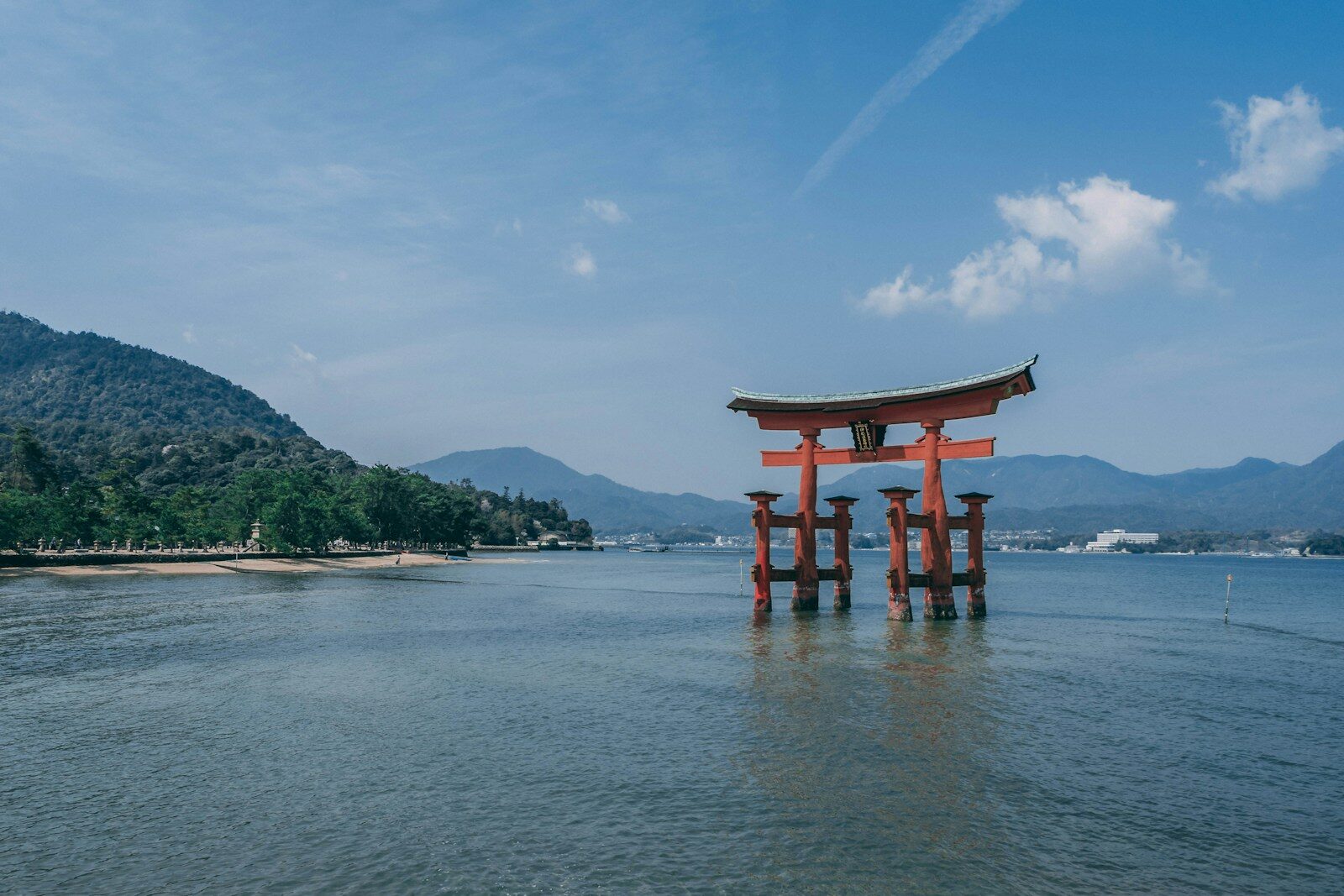
One such symbol is the Torii, the traditional gate marking the entrance to a Shinto shrine.
At first glance, it appears to be merely an architectural feature: two vertical posts and two horizontal beams. A simple structure, with no doors, no walls and no mechanism to prevent passage.
And yet, it is precisely this simplicity that conceals a profound question.
How can a gate that does not enclose anything serve to separate things?
In Japanese tradition, a Torii is the gate marking the entrance to a jinja (Shinto shrine). But what is fascinating is that it is not a gate in the functional sense. It does not enclose anything. It has no doors. It stops no one.
In Shinto tradition, there is no official interpretation of this gate’s architecture. The Japanese are surprisingly reluctant to attribute fixed symbolism to sacred objects. For them, the Torii is first and foremost a sign of passage into the realm of the kami, not a metaphysical diagram.
Nevertheless, we can say that the torii consists of:
- two vertical posts (hashira);
- the upper beam (kasagi);
- a second beam, slightly lower down (nuki).
This second beam actually serves a structural purpose: it connects the two posts. But this is also where the symbolism comes in.
The two vertical posts may suggest:
- earth and sky;
- man and the transcendent;
- the finite and the infinite.
And it is the horizontal beam that makes this relationship possible. It does not mix them up. It does not confuse them. It unites them.
An extraordinary metaphor, just as one might say that revelation does not unite two different realities, but makes possible the relationship between things that seem separate.
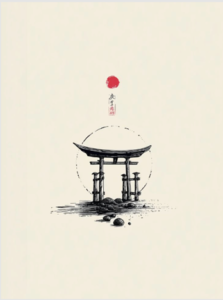
Another element is the horizon, which may be an image, or a stylised red disc, or even a horizontal line. The most common interpretation of the red disc is the sun. In Japan, the red disc is most often associated with the sun.
It is no coincidence that the Japanese flag features a red circle. Japan is called Nihon, meaning ‘Land of the Rising Sun’.
The sun represents light, the beginning, life and cosmic order. In Shinto, the sun goddess Amaterasu is the central figure. Therefore, a torii gate in front of the solar disc may suggest tthe entrance into the light of cosmic order.
In Japanese culture, there is always an interplay between the vertical and the horizontal. The vertical signifies life, growth, aspiration. The horizontal signifies stability, order, harmony. The torii exists solely through the balance of these two. If the vertical represents ascent, the horizontal represents tranquillity.
In Zen, it is often said that enlightenment does not mean climbing. It means seeing. The horizontal line is the gaze that has settled.
The torii is a gate that does not separate by means of a wall, but through consciousness. You pass through it and walk on the same earth, under the same sky. Nothing has changed physically. And yet, tradition holds that you have entered into a different way of being present.
In the West, sacred space is often bounded by walls; you enter a church, a monastery, a temple. In Japan, the beginning of the sacred is signalled by an opening, not by a closure. It is almost a paradox. The gate exists precisely because it does not obstruct passage.
There is also a symbolic aspect. In Shinto, the world is not divided into two completely different universes, one profane and one sacred. The sacred is already present in nature. A tree, a spring or a mountain may be the dwelling place of a kami.
The word kami is almost impossible to translate with a single word. It does not necessarily mean God, a god or a spirit. It can refer to a mountain, a very old tree, a spring, a waterfall, an ancestor or a force of nature. Even a certain presence that inspires awe and respect.
Kami is rather the presence of the ineffable in the world. It is not separate from the world. It manifests itself through the world.
Therefore, ‘kami space’ is not merely a place where God dwells. Rather, it is a place where the presence of the spirit is recognised. The difference is important. The Japanese do not say: ‘Here God begins’, but rather ‘Here you must be mindful’.
It is a subtle yet profound shift. That is why the torii exists. The torii does not say: ‘Beyond this point, heaven begins.’ Rather, it says: ‘Beyond this point, you enter a place that demands a different kind of attention.’ It reminds you to slow down. To be still. To look. To stop rushing in.
The torii does not create the sacred. It says: ‘From here on, look differently.’ It does not change the place. It changes the way you look.
From a philosophical perspective, you could say that the torii is a symbol of a shift in perspective, not of an ontological change. Exactly the same path. Exactly the same garden. But a different gaze, a different view. In Zen there is a similar idea. There are not two worlds, separated by a gate. There is the same world seen differently. The gate does not lead you into another reality. It is a gateway to a different interpretation of the same space.
‘The gateway to the sanctuary of another way of seeing.’ – It is not the entrance to a new religion, a new doctrine, or a new faith. The torii does not open up another world; it reminds us that the same world can become a sanctuary when our perspective changes.