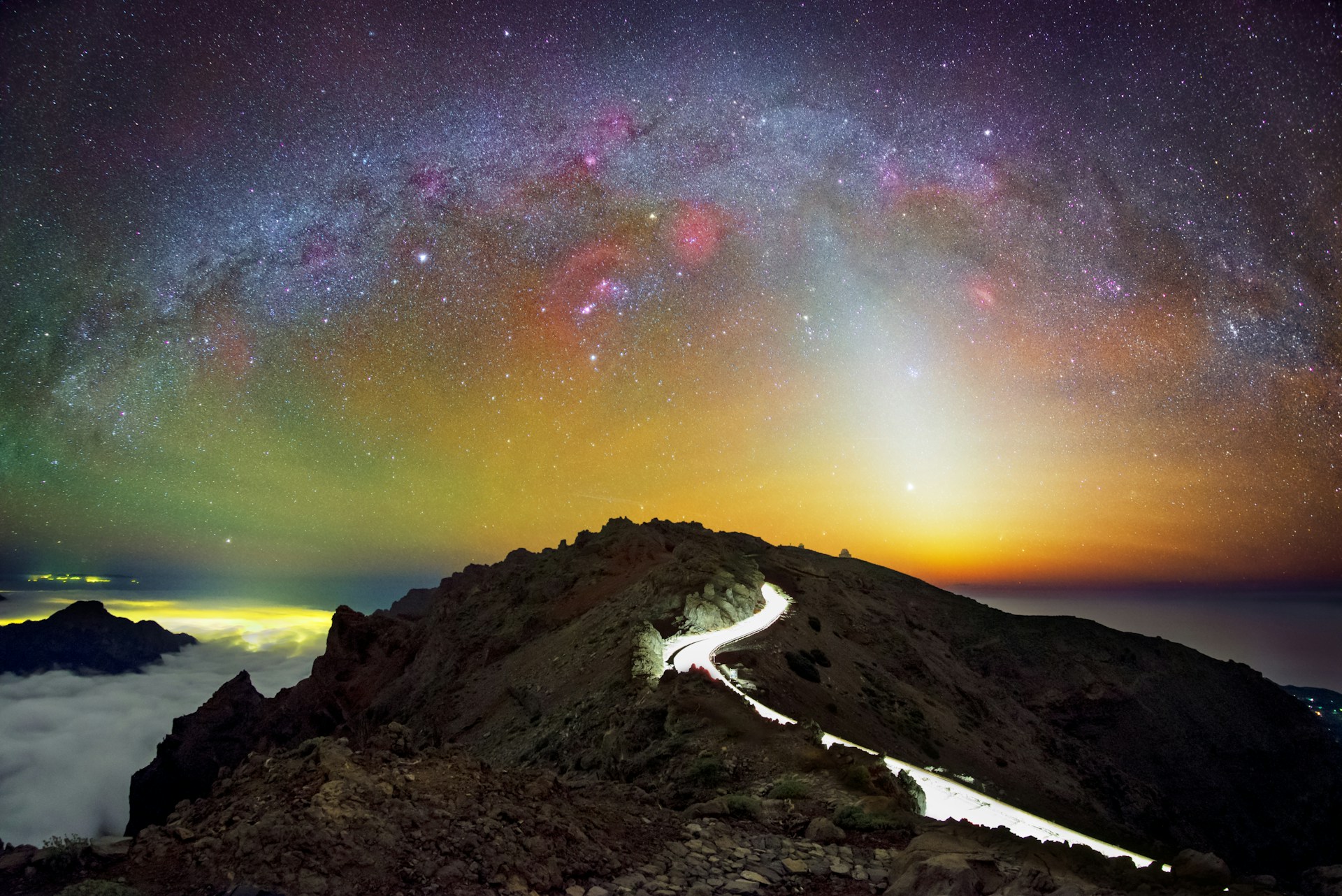
Since the dawn of time, the complex yet extraordinarily precise organisation of the universe has fascinated humanity.
Are you aware of the fact, that an infinitesimal deviation in the orbital path of a planet in our solar system would sow chaos, one consequence of which would be the disappearance of all traces of life on Earth?
Certain enlightened thinkers have held that the true human being – that is, not merely a biological organism but one animated by a soul and a spiritual life – is structured in the image of the universe, calling it a ‘microcosmos’ or microcosm. Regarding this small universe or microcosm, Empedocles – a philosopher of the fourth century BC. tells us:
“Equal to itself everywhere, boundless, ‘Sphairos’ (that is, the radiant sun) exists – perfectly round, joyful, and motionless.” 1
Today, we perceive only a limited fragment of ‘Sphairos’ – our body – animated by a consciousness that is equally limited, being essentially determined by our sensory activity. Yet, despite this obvious limitation of our physical, emotional, and cognitive capacities, we remain driven by the desire to transcend these limitations. But what is the origin of this desire that compels humanity to constantly seek new horizons – horizons whose limits will sooner or later be discovered, only to prompt a renewed attempt to transcend them?
This impulse springs from a secret sanctuary – a realm of the absolute – situated in the deepest recesses of our soul. Various spiritual schools have referred to it as the “Spark of Light,” the “Mustard Seed,” the “Rose of the Heart,” the “Grail,” or, in the Middle East, the “Sacred Deposit.” Yet our consciousness perceives nothing of this silent presence, save perhaps fleetingly as a faint nostalgia that sweeps through one’s being, casting it into a state of unease that nothing – and no one – can erase. Often, our consciousness interprets this inner impulse as a chaotic search outside our own microcosm, leading us down endlessly winding paths – like a colossal maze from which escape is utterly impossible.
This quest for the absolute also lies at the heart of much theological discourse. Traditional religious teachings have offered humanity an explanation framing man’s place in the universe as the product of divine will; the entire religious edifice positioning itself as an intermediary between humanity and God. Over the centuries, however, this belief has fractured – slowly but inexorably – partly due to the work of certain individuals regarding the laws governing the universe, thereby relegating the foundational dogmas of major religions to the realm of the irrational. Notable figures between the 15th and 18th centuries such as Copernicus, Galileo, Giordano Bruno, and also Newton who helped lay the groundwork for the experimental method, that is, devising and conducting experiments and models to replicate observed phenomena, and using these models to trace back to the primal principle, to the creative idea itself. Discovering these laws of cosmic organisation marked the first step toward understanding the mystery of life.
In its early stages, however, the scientific approach was deeply imbued with metaphysics – or rather, rational mysticism. We have recently discovered, for instance, that Newton – the father of Newtonian physics that underpins our modern worldview – was, before becoming a scientist, a committed alchemist who drew upon Hermetic traditions. In reality, Newton viewed the universe as a cryptogram composed by the Almighty, as a riddle whose meaning was meant to be deciphered. Until the advent of modern science, Nature was perceived as a living reality, animated by its own Soul. However, the mechanistic philosophy that emerged in the 17th century gradually imposed the idea that everything should be conceived on the model of a machine and that the Soul should be replaced by the concept of force – with the heavens, planets, plants, animals, and even human beings themselves all obeying these forces.
The hypothesis that God is a fundamental element in the organisation of the universe became superfluous; the wisdom of those who strove to develop a vision of the world, of humanity, and of life – particularly the early Rosicrucian, uniting reason and faith in harmony – gradually gave way to an exclusively rational approach, the very approach the greater part of humanity follows today. The culmination of this process was undoubtedly the exclusion of the subject – and so of their consciousness or soul – from the process of knowing the object. The consequences of this separation are incalculable…
The psychoanalyst Jung wrote:
“Science in its entirety is, however, dependent on the soul in which all knowledge is rooted… It is extremely surprising that the Western world seems to fail to appreciate this situation.” 2
By losing the soul as an organ of knowledge, science has precluded itself from answering the question of meaning – a point Plato emphatically highlights in The Republic, Book VII:
“Now, our reasoning […] demonstrates that this faculty of knowledge is present – along with the most appropriate organ – in everyone’s soul; and that, just as an eye could only turn from darkness to light by rotating the entire body, so equally must the whole soul – along with the organ of knowledge – be turned away from passing things, until it becomes capable of enduring the contemplation of Being in its most luminous aspect: namely, what we call the Good.” 3
Through this exclusion of the soul, science has defined its own sphere and methodology. It has gradually imposed its vision of the world and of life, and it is this vision that forms the current foundation of our materialistic culture.
But let us not be mistaken. We wish to acknowledge the remarkable consequences of scientific research in the technologies that shape our daily environment: information technology, energy, new materials, genetic engineering and so forth. Yet, do these technologies enable us to answer the fundamental question: what is the meaning of life?
Certainly not! And yet, is this question not fundamental? Why, then, such ignorance? Why such a drift – where the fundamental questions of existence are not only excluded but even deemed unwelcome in our society today?
The root of this drift lies in the rift between inner – or sacred – science and materialist science. For today, there exists an inner science known to a limited few seekers whose hearts are filled with a yearning to understand and realise the meaning of life. Their primary task is to discover the plan that imprints its pattern upon the workings and organisation of the universe. This discovery is made possible by the awakening of a genuine higher intuition – a mode of operation for the imagination in which it draws sustenance from the living springs of the Universal Spirit.
Unlike the scientific approach, which seeks to isolate the individual parts of a system in order to study them – thereby attempting to reconstruct the whole and deduce its organisational laws – Sacred Science is founded upon a holistic vision of humanity, life and the universe. It begins with humanity, for the human being is both the agent and the subject of this knowledge. Sacred Science posits that the human being is far more than a complex arrangement of atoms animated by biological life and governed by energetic processes that are more or less understood. The human being is also an element or organ of a true living Body (the ‘microcosm’ or ‘Sphairos’) – whose constituent elements cannot be grasped or studied using current scientific instruments and theories. A master of Sacred Science, Jan van Rijckenborgh – one of the founders of the International School of the Golden Rosycross – has vividly described this living body, this microcosm. Here arises the mystery of life as an element within a cosmic-scale plan; its ultimate purpose – conveyed through countless myths and legends – is the awakening and liberation of the Being of Light that lies dormant within each of us. It is Life itself that lies at the heart of this science – not biological life, even though that plays a decisive role, but the Life whose origin lies in another Reality, a field of perfect Life and Light. Finally, this vision extends to the universe, which is organised in the image of the microcosm, thereby aligning with the ancient Hermetic insight:
“As above, so below.” 4
Clearly, the aim of this Sacred Science is not to increase humanity’s material comfort. Nor does it seek to provide an extra measure of moral or spiritual comfort, even though such things may result from its practice. Its sole objective is to restore within the individual the latent faculty of perfect knowledge – that is, an inner understanding of life, being and the world, free from any belief systems or external conditioning. The key that unlocks this perfect knowledge lies in consciousness – the very consciousness that enables us to question the meaning of life and refuses to accept that life is merely a biological accident in the unfathomable history of the universe. It is from the deepest recesses of our consciousness that there arises a sensitivity towards goodness, towards noble sentiments, and also towards that fleeting nostalgia which sometimes grips us so deeply that, when it fades, it leaves behind a trace of “unease” – something that neither time nor anyone can erase.
We see the emergence – at a time determined solely by our own inner journey – of a new vision of the world and of life. The signs of this are already appearing through certain discoveries in quantum physics, which hint that a reality unknown and imperceptible to us is taking shape within the surrounding universe. The only way to perceive this reality lies in a shift of consciousness – a shift that itself must originate from that very reality.
This brings us to the threshold of the sacred – to the gateway of Sacred Science whose keys (those mysterious “mystic keys” to which Newton referred) lie hidden within us, in the very place where we never think to look.
It is toward this inner science that the science of nature can – and should – lead us. The true function of natural science, with its extraordinary capacity to investigate both the infinitely small and the infinitely vast, is to preserve our capacity to wonder at the marvels of the universe and of life, thereby prompting the human soul to ponder the mystery of existence. This questioning can go deeper, eventually impelling the individual to seek a reality that transcends the limitations of their consciousness and their myriad beliefs. In doing so, secular science will have guided the individual to the threshold of Sacred Science – one that connects them to the perfection of a timeless, infinite reality.
References
1 Empedocles, 490-435 BC. Fragments
2 Erwin Schrödinger,’Spirit and Matter’ 1958
3 Plato, The Republic, Book VII
4 Hermes Trismegistos, Tabula Smaragdina