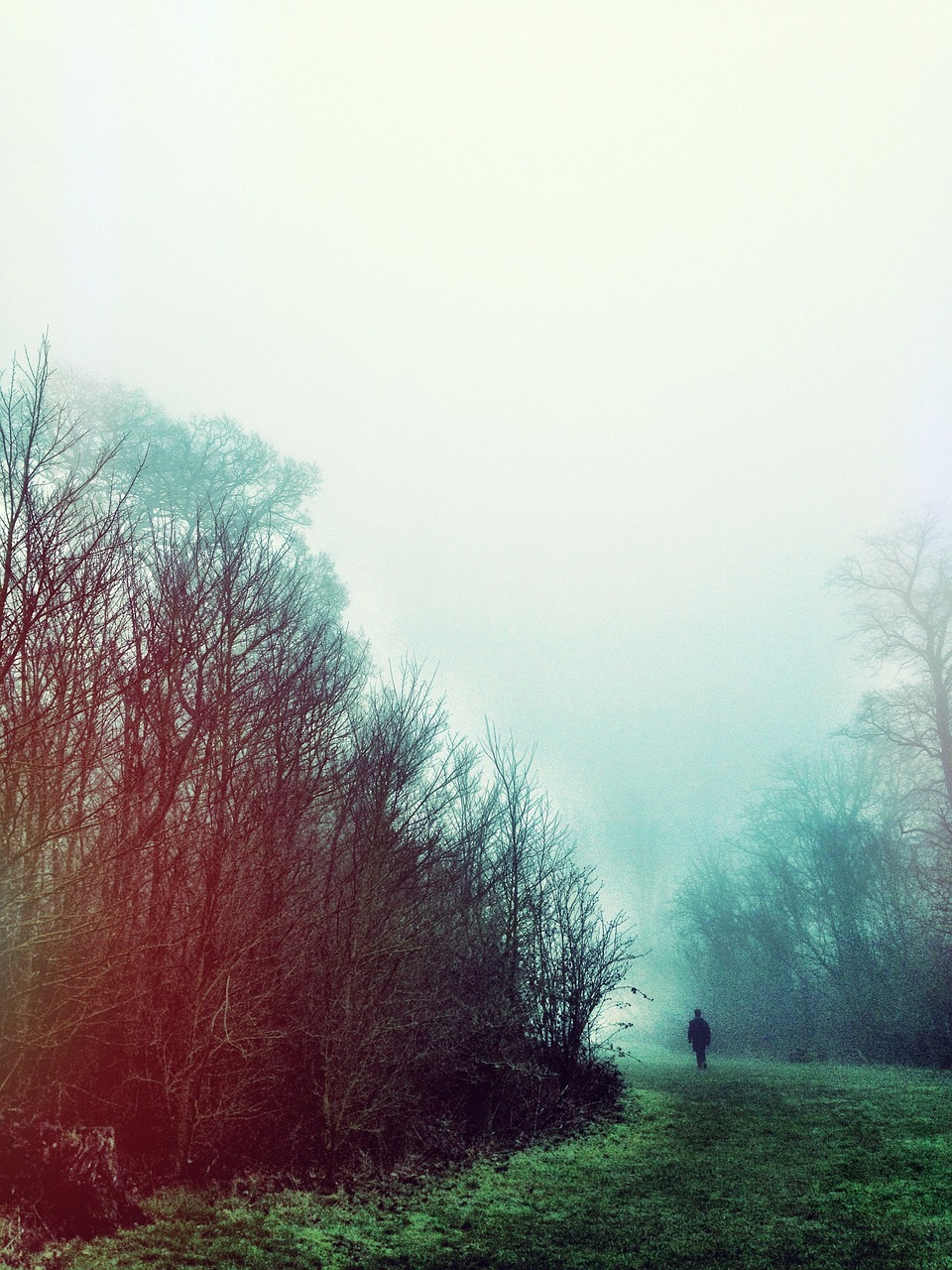
You can only feel estranged if you have an idea of home. Only the loss of home awakens our longing, teaches us to appreciate what we have lost and to search for it again.
When it came to itself from the vortex that had sucked it in, it looked around and – recognized nothing. Where was it? Where am I? it asked itself and looked around. Horror overcame it. It was locked up! Just get out of here, a voice inside it screamed, but as much as it wriggled and screamed, it remained trapped in this heaviness of flesh. Tired from its futile efforts it fell asleep. Then it grew light and bright. Sound, space, calm and peace were present. When it opened its eyes, it felt that it was being held. The food tasted strange, but also a little sweet. It looked around cautiously…
Being a stranger means to be homeless…
and can mean the place or a feeling.
Being a stranger means not belonging…
to the family, group, clan, class, nation, culture, religion.
Being a stranger can be dangerous…
for the stranger. He is insulted, threatened, vilified, slandered, imprisoned, locked out, condemned, crucified.
Being a stranger demands openness…
to the unknown. This requires impartiality and a potential openness that can be trained as a new attitude. It could also be described as a constant “dying and becoming” (of one’s own concepts, habits, ideas, beliefs, etc.).
Does being a stranger mean being separated from the WHOLE?
The separation from the unrecognizable, from Tao, the emptiness or nothingness to becoming something is creation. From this unknowable, a ray of thought from SPIRIT-Fire is sent into the primal substance, the mother-matter. Let there be light (consciousness develops). This is how the SPIRIT reveals itself through and in its creation. A creation that becomes a counterpart that mirrors and reflects. Without this first, only apparent separation of the WHOLE into SOMETHING, nothing can become. This separation is only apparent because: ‘All things are made through the same (the WORD), and without the same (the WORD) nothing is made’, as it says in the Gospel according to John 1:3. From unity into multiplicity, into an expansion of creation. For this creation has not simply become and been finished. It conceals a plan that contains a continuous development.
Being a stranger means to be different…
and depending on from which side you look at it, who or what is foreign is different or unknown. It is special but also separate. The drama of man is that he has separated himself from the original plan by his own will. Because the freedom to say no is also inherent in the plan. It is this freedom that makes other things possible. Where would the freedom we want to have be without the possibility of saying no?
Being a stranger can arouse curiosity…
and opens up the search for the unknown. The urge to explore is awakened. You expose yourself to the unknown. Eve ate from the apple because she was promised added value: “If you eat from the tree of the knowledge of good and evil, your eyes will be opened, and you will be like God” (Genesis 3:5). A promise that drove her (and Adam) out of their first home, out of paradise, unconsciousness, sleep. Saying no can broaden the horizon, but it comes at the price of pain. Because without being born and dying, we cannot truly recognize, appreciate and love the central tree in paradise, the tree of LIFE.
Becoming a stranger can mean alienation…
from oneself, from the world, from God. The feeling of alienation is expressed in Johann Sebastian Bach’s cantata BWV 82 “I have had enough”. After endless rounds on the carousel of being born and dying, after the human soul has gorged itself on mostly unpalatable food, after everything tastes stale and flavorless, it has had enough. The poet Friedrich Rückert was obviously also familiar with such feelings. His poem: “I am lost to the world” bears witness to this:
I am lost to the world
with which I used to waste so much time,
it has heard nothing from me for so long
that it may very well believe that I am dead!
It is of no consequence to me
whether it thinks me dead;
I cannot deny it,
for I really am dead to the world.
I am dead to the world’s tumult,
and I rest in a quiet realm!
I live alone in my heaven,
in my love and in my song!
Being foreign can mean danger for the old, the traditional, the local…
who feel threatened by the new, the unknown.
Being a stranger can arouse fear…
of the unknown. Facing the fear of the unknown can promote trust in oneself, in the Other. Rainer Maria Rilke says in his poem Autumn:
The leaves fall, fall as from far,
like distant gardens withered in the heavens;
they fall in slow, negating gesture.
And in the nights the heavy Earth, too, falls
from out the stars into the solitude.
Thus, all doth fall. This hand of mine must fall.
And lo! the other one:—it is the law.
But there is One who holds this falling
infinitely softly in His hands.
It takes courage to expose yourself to the unknown, to enter new territory, to take the plunge and to deal with the vicissitudes of life, to face your fears, ready to continue to grow despite them. Breaking away from old habits for example, means becoming aware of your habits and recognizing them as such, recognizing the patterns in them and adopting a different, perhaps even neutral, observational perspective, so that the opportunity for a new, spontaneous understanding with dynamically adapting action can arise.
The philosopher Peter Sloterdijk says: “The person who constantly recreates himself as a practitioner becomes a being that goes beyond himself.” In this affirmation of oneself and one’s possibilities lies faith and trust in one’s inherent learning power. “Help yourself and God will help you” used to be said. Rilke expressed this somewhat more poetically: “But there is One who holds this falling infinitely gently in His hands.”
Being a stranger means not being recognized
But don’t we want to recognize ourselves in our work and in the deepest sense also be recognized (and acknowledged) by others? Doesn’t the spiritual, the God in His creation, His work, perhaps also want to recognize Himself and be recognized by it? To be able to be reflected in an ever -clearer mirror of consciousness or soul of a creation awakening from unconsciousness, a humanity coming of age, which, free from egocentric shadows, responds through a growing new soul consciousness to God’s call: Adam, where art thou? (Gen 3:9) In saying no lies the real freedom to no longer allow oneself everything, as consciousness progresses. We show ourselves and respond to the call through our responsible actions.
Being a stranger makes it possible to have an idea of home
You only can feel estranged if you have an idea of home. Only the loss of home awakens our longing, teaches us to appreciate what we have lost and to search for it again. This is how the Swiss poet Luisa Famos expresses it in her poetry collection Unterwegs in Viadi (On the road in Viadi):
I am the daughter of the wind
Together we return
To the lands
Where I was thousands of years ago
Everyone there
Know me
I lay my forehead
On their earth
And wait
Until they have passed judgement
The judgement on me.
The wind as a metaphor for SPIRIT, the land to which we can voluntarily return after thousands of years, where everyone recognizes each other. The forehead is placed on this (new) earth and in this heaven of consciousness. And what is the judgement? The “Last Judgement”, as it says in Matthew 12:36,37. Isn’t every day “the last day”? In the Eternal Now, we can freely decide every second whether we want to be part of the great plan or fall out of the higher soul consciousness, the All-One, again. In this way, we ourselves are choosing our original judgement. Resurrection and fall happen daily, depending on where we direct ourselves. We are the ones who divide and separate. But aren’t we all on the path? In recognizing and affirming the current state lies the power to move on.
Being a stranger can awaken a longing…
for the original home that we have left, lost, forgotten. Recognizing it (again) means that it is no longer foreign. Love is the key, consciousness is the keyhole through which new spiritual and emotional spaces open up.
Being a stranger means to know more
Those who have ventured into the unknown have dared to do something, have broadened their horizons, have changed, been transformed, have been reborn, have opened up new levels of consciousness, speak new languages (Pentecost), wear new, pure clothes. This individual rebirth “from Water and Spirit” means the magnetic attraction of higher vibrations, ethers from a sacred, spiritual field of consciousness in which we can breathe here and now.
The expansion of this sacred spiritual field forms the added value that each person will contribute at his time as an affirmative response to the call from home, the spiritual core within. God is the All-One that can now express itself individually through the human being. From a transcendent, unrecognized God to a tangible, immanent SPIRIT, in and from which one lives and thus becomes fruitful for the world. Everything in the world wants to expand and multiply. The biblical injunction “Be fruitful and multiply” (Genesis 9:1) can thus also be recognized from the SPIRITUAL aspect. What needs to be increased is not exclusively an uninhibitedly reproducing biological creation, but the first development, the one in connection to the original intention (by God). This is the value that the fully conscious new being, the spirit-soul-man, can, as an expression of love, voluntarily add to creation and thus to the whole within the eternal becoming.
Friedrich Rückert, Ich bin der Welt abhanden gekommen, aus dem Zyklus Liebesfrühling
Luisa Famos, Unterwegs in Viadi, Gedichte Rätoromanisch und Deutsch
Rainer Maria Rilke, Die Gedichte