The life of Konstantin Tsiolkovsky – Through thorns to the star
Observing celestial bodies is not only scientifically exciting, but above all emotionally moving and fascinating. The infinity of the universe touches our innermost being, it awakens awe and the desire to become part of a greater whole. Konstantin Tsiolkovsky (1857–1935), a Russian visionary and pioneer of space travel, was captivated by the idea that human beings repeatedly enter the cosmos in order to perfect themselves.
I turn to you, cause of all being!
You have carried us away to the sky before we knew it. The sky is our home. It will remain so in the future, only it will look different then. You will give us the entire solar system.[1]
[…]
But there is another heaven – a metaphysical, higher, mental one – which we will enter when we lose this physical shell. There is another world – a spiritual one – that will open up to us when we have completed our life’s journey. This world is inaccessible to our senses, but it will appear before us in due course when we stand before it. The dream of our life will be interrupted, we will rub our spiritual eyes and see what we do not think about now.[2] (Konstantin Tsiolkovsky)
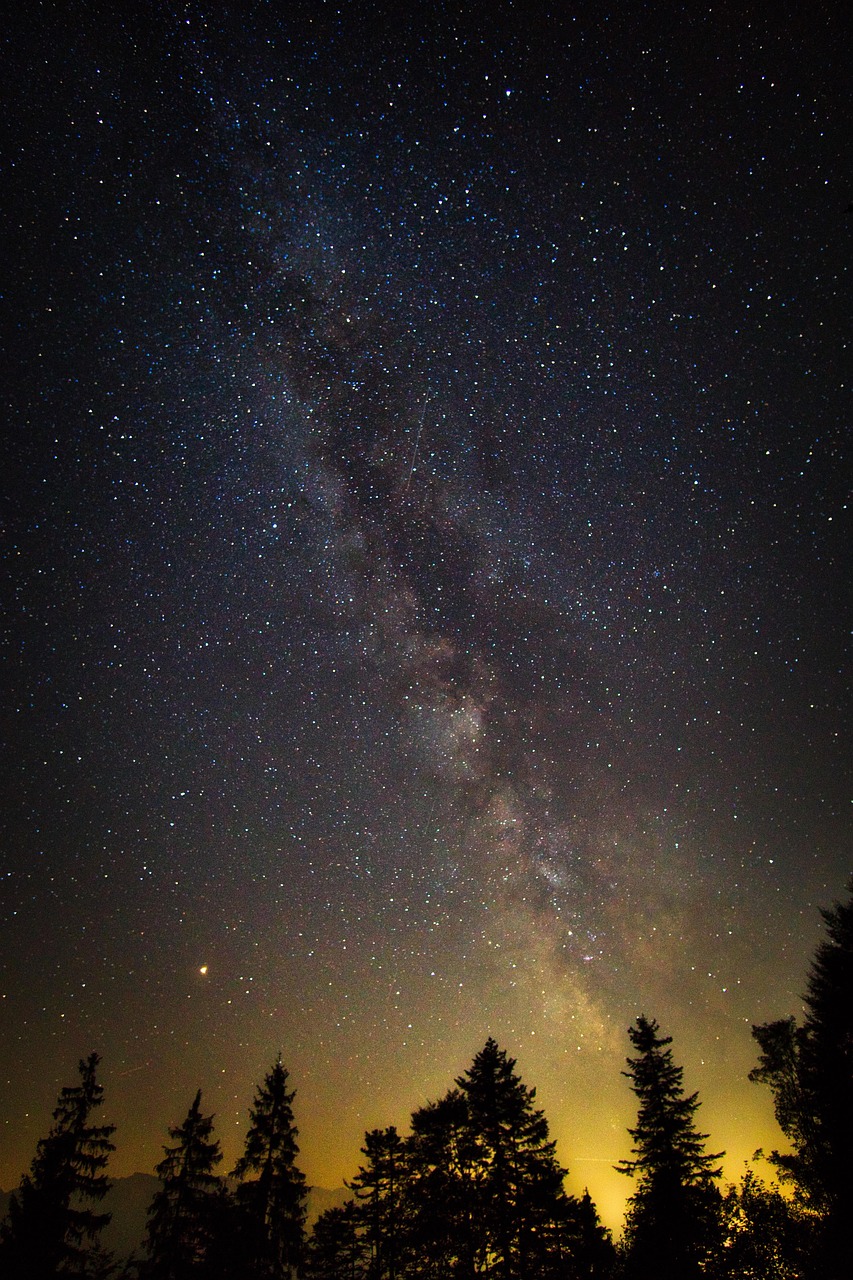
When I look up at the stars on clear nights, I often experience a deep sense of wonder and feel humility in the face of the infinite vastness. Even as a child, I would sit at the window for hours admiring the twinkling of distant celestial bodies – then as now, I feel a quiet, almost awe-filled connection to the starry night sky. It is as if these shining points in the sky were the eyes of the heavens looking down on me and inviting me to think beyond the limits of my own existence.
Observing celestial bodies is not only scientifically exciting, but above all emotionally moving and fascinating. The infinity of the universe touches our innermost being, it awakens awe and the desire to become part of a greater whole. Konstantin Tsiolkovsky (1857–1935), a Russian visionary and pioneer of space travel, was captivated by the idea that human beings repeatedly enter the cosmos in order to perfect themselves. He maintained friendly relations with members of the Theosophical Society in Kaluga – he may have been a member himself – and studied the work The Voice of the Silence by H.P. Blavatsky. The search for truth and perfection drove him. He was convinced that cosmic bodies arise from the creative power of the universe, a power he traced with the help of his imagination. Tsiolkovsky studied the Gospels and was an avid reader of the works of Jules Verne. Gradually, he developed into a scientific researcher who sought to understand the wonders of the outside world on the basis of inner worlds. The external, he believed, is produced and transformed by the internal.
Tsiolkovsky was fascinated by the celestial bodies from childhood and devoted his life to space exploration. He believed this was the next step in evolution. His cosmic philosophy encompassed a belief in a higher, cosmic intelligence that guides the universe. He was convinced that humanity was destined to explore space and, in doing so, to understand the secrets and teachings of cosmic intelligence that it must follow in order to achieve perfection. Despite his visions, he remained humble in the face of the vastness and boundlessness of space, emphasising that all human knowledge is nothing compared to what the universe holds.
Eyes of the sky
The human eyes can become ‘eyes of the sky’. They can gaze deep into space, amplified by telescopes, and capture light and other radiation, becoming humanity’s gateway to the cosmos. Our eyes open us up to the influences of planets, stars and incomprehensibly distant galaxies. At the same time, we can see the material origins of the cosmos, the ‘chaos’, the disorder. In addition to the outer eyes, there are the inner ones, the spiritual ones. They are ‘eyes of heaven’ in a special way, because they are able to explore the depths of the divine order and discover the open heaven within ourselves. The inner eyes invite us to look not only with scientific curiosity, but also with spiritual openness. They can become a mirror of the open heaven, receiving light and emitting light. Their radiant power touches deeper layers within us, in our small ‘cosmos’, and awakens a longing for intimate connection with the infinite, the unknown great cosmos. When we look at the stars, we often feel a quiet joy: our own inner search and the vastness of the universe come into contact with each other, interweaving. Contemplating the sky can give us comfort, give us hope and help us to discover the meaning of our lives.
Two paths to initiation
Rudolf Steiner points to two paths of initiation that can be united in human beings: While in Egyptian initiation the candidate completely withdrew from the context of the outer world in order to enter into his soul, the student of the Nordic mysteries was elevated into the cosmic worlds. In Nordic initiation, the inner self poured out into the universe, up to the zodiac, the twelve signs, so that the initiate could read and experience the star script, the “Word of the world“, as truth. Through imagination and inspiration, he rose to cosmic intuition in order to absorb the subtle divine-spiritual processes in the cosmos. Thus he awoke in the etheric worlds, and as his soul poured out into the cosmos, it experienced it in its greatness and vastness. [3]
Tsiolkovsky’s spiritual vision
I would like to inspire you to contemplate the universe, the destiny that awaits us all, and the wonderful history of the past and future of every atom. [4]
Tsiolkovsky suffered several blows of fate in his life: from the age of nine, he lost his hearing after contracting scarlet fever; later, he had to cope with the death of his four sons, including the suicide of Ignat, who was a promising scientist and whom Tsiolkovsky had hoped would be his spiritual heir. Added to this were periods of oppressive poverty. But despite all this, his spirit transfigured this man and equipped him for his tasks:
This misfortune softened my heart, tamed my character at least a little, directed my thoughts to heaven, to the future, to infinity, and perhaps saved me from much misfortune. Without this suffering, I would not have written my ’Ethics‘. [5]
Each phase of his life broadened his sphere of influence, opened up new horizons for him and gave him deeper insights. His motto in life was: ’Do not live life in vain, advance humanity.‘ He saw the colonisation of space as a moral duty that serves the perfection of the human spirit. He assumed the possibility of overcoming death and spreading life throughout the universe.
Tsiolkovsky created a system of spiritual teaching that contained at its core reflections on the symmetry of spirit and matter and sought to reconcile the polarities of ’above and below’ as well as inside and outside: according to this, the depth of matter corresponds to the higher cosmic circles. To the extent that we ascend into the heights of the spiritual cosmos, we enter into the depths of matter. Between the heights of the spiritual cosmos and the depths of the material cosmos there is an intersection: the spirit-soul human being. In addition to his material form, he possesses a spiritual-soul form consisting of spiritual atoms, the smallest particles of a spiritual DNA, which is the basis of his development and his great potential. The human being can unite the material cosmos with the spiritual one and is able to transcend all material things.
Tsiolkovsky sought knowledge from the primordial source, which he called the cosmic Christ. The marriage between him and his wife, who enthusiastically participated in the exploration of cosmic infinity, corresponded for him to the spiritual principle of the duality of male and female. Both studied the Gospels [6] together and arrived at insights that point to a path of liberation that frees people from church dogmas and fearful stereotypes. Tsiolkovsky testified that it is not church religion that is the basis for connection to the spirit, but inner knowledge – gnosis.
The justification of our existence in infinite cosmic space goes hand in hand with the longing for gnosis – for deep inner knowledge. For Tsiolkovsky, too, this longing was the signpost pointing the long way to the transcendence of matter by the spirit. The transformation takes place in and through the soul of the person who sets out on the path to perfection. His soul power becomes a ‘vehicle’ capable of breaking through the walls of the dungeon of material existence and becoming a living part of the open heaven. Such a person realises for himself and others the hermetic principle ‘As above, so below’.
From a dedication to Konstantin Eduardovich Tsiolkovsky by his student A.L. Chizhevsky
We gaze with our heads raised into the vastness of the night
and want to understand the laws of the world in the light of the stars,
unite them with the destiny of life and stretch the ropes from us to Altair [star in the constellation Aquila].
I, like you, look up at the shining choir. […]
For us, everything is one: in the small as in the large.
Common blood flows through the veins of the entire universe.
You have come to me, and we think as one,
in inspired joy
beyond all earthly time
and beyond earthly space.
[…]
We are children of the cosmos,
and our homeland
is so deeply connected and unbreakable through commonality
that we feel fused into a single entity,
that at every point the world, the whole world, is concentrated …
Life – everywhere there is life in matter,
in the depths of substance, from one end to the other
it flows solemnly in battle with the great darkness,
suffering and burning, without ever falling silent.
[1] This note is dated 1923. The autograph is kept in the archives of the Russian Academy of Sciences, F. 555. Op.1. D.431. Bl. 2-4, published in the collection: K. E. Tsiolkovsky, Cosmic Philosophy. Moscow, 2001. p. 271 (in Russian)
[2] Konstantin Tsiolkovsky, The Theory of Cosmic Ages, 1932 (1977)
[3] Rudolf Steiner, The Gospel of John, Archiati Verlag, 2006, pp. 115-116; see also Trotten Mysteries – LOGON
[4] Konstantin Tsiolkovsky, The Monism of the Universe, 1925 (in Russian)
[5] Valery Nikitich Demin, Tsiolkovsky. Lives of Remarkable People. A Series of Biographies, Molodaya Gvardia Publishing House, 2005, Moscow, pp. 79–80, 119–122 (in Russian)
[6] van Ivanov (pseudonym of K. Tsiolkovsky), The Carpenter from Galilee. The Essence of Evangelical Traditions, 1924–1926, ARAS. F.555. Op.1. D.438. L.32–61 (in Russian)