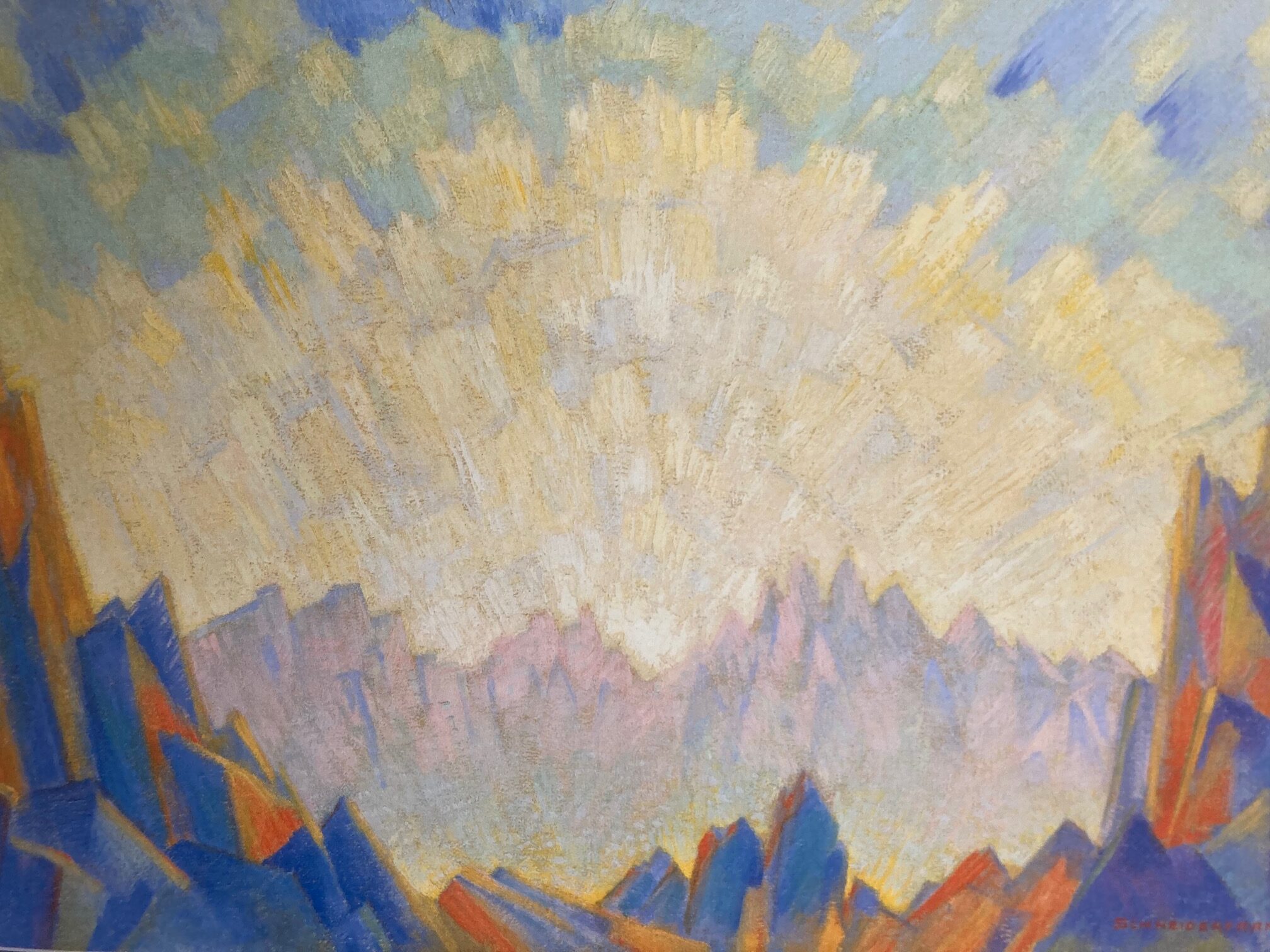
Sometimes your eye falls on a book that immediately makes you curious. It happened to me with ‘Worlds’ of Bô Yin Râ.
On the front I see, brilliant and powerful, radiating light of an invisible sun above a deep blue, wavy sea.
Inside colourful paintings, executed in oil. The work touches me. It turns out to be a series of cosmic images, created between 1920 and 1922. From far back, but it looks timeless. When I get home, I take the small book The Way to God and The Realm of Art by Bô Yin Râ from my bookcase and leaf through it.
It is high time to bring his work back to attention. In ‘The Realm of Art’, Bô Yin Râ expresses his vision on art.
He writes:
‘A true artist creates from an inner necessity and arrives at personal forms of representation. For too long, it has been thought that real art is a proof of skill. After all, art comes from ability. Yes, but it is about an ‘ability’ that flows from the soul, about a capacity for creative development and not about a learned skill.’
And he continues:
‘In human creation the eternal spirit, which flows from the Primordial Being, can reveal itself. For every true artist called is a bridge-builder who connects the realm of the sensory perceptible world with the shores of the transcendental.’
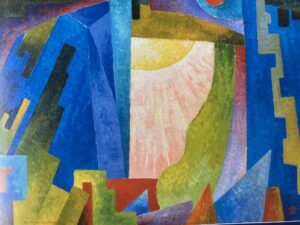
The first work in Worlds is called ‘Emanation‘ (2): the outflow of Primordial Being. A radiant primordial fire sun, the active ‘innermost being’ from which world systems emerge. With this work, Bô Yin Râ tries to make visible that from which all life has been forced out. So that we too will not forget where we came from. For the further removed from the one, all-generating primordial fire sun, the more the forces flowing from it lose the resemblance to its Being. In the very outer they even become counter-being forms. But, he writes:
‘Remember also that the outer comes from the inner and all opposing still shows the last traces of its origin from the primeval light!’

The primeval eternal emanation of eternal love expresses itself in eternal will to become. Bô Yin Râ called this work In Principio Erat Verbum (3), in the beginning was the Word. From the Word everything is ordered according to one’s own measure, according to one’s own number. The primeval word realises itself in its innermost being to fulfilment. But his creative will to become has not yet come to an end.
That which is one in the innermost realm of the spirit, becomes twoness. Bô Yin Râ paints a cosmic workshop (4), where time and space are created. Where all polarities arise and seeds of emerging worlds reveal themselves. One small world in that big whole is me and also you.
But we wander in the labyrinth of centuries and centuries old (5). The fire, the essence of life, is buried under the forms that have arisen. “Here you are now,” writes Bô Yin Râ, “the paths that the fallen spirit man – ‘fallen’, since he turned away from his primeval homeland to experience himself at its extreme creative limits – has to travel on these outer worlds, in order to be able to wrest himself from the folly of his volition and to be able to muster the will to return to the Light of his eternal homeland.”
The booklet The Way to God connects to that return. Seven of the twenty paintings from Worlds are included in this article. From the booklet The Way to God some quotes to briefly sketch a picture of the way. Already on the first page, Bô Yin Râ deals with all the images and holy books in which we have come to believe as if that were God. That is not ‘faith’. Bô Yin Râ calls it ‘a self-created chimera’. The light of the primordial fire sun radiates within you of itself.
It is striking how Bô Yin Râ finds words to place the path very directly within yourself. So he asks you what you feel inside, when reading the following words:
‘You will meet your own life in its eternal fullness; you will see yourself rising up into the Light through the power of light. You will see that you are united with ‘God’ – the ground of Being of all being.’
Even though you can’t explain it yet, but the inner turmoil you feel, he calls the power of real faith. The way to God starts with that ‘something’ in you. This belief is justifiable for yourself. Here there is no delusion, no opinion, no suspicion. When you trust the “something” in you, it makes you believe in something deep in yourself. The mind will certainly have all kinds of objections and will try to prevent your agreement with that ‘something’ within you.
Thinking turns out to be a good instrument for penetrating into the things of the earth, but it fails as an instrument for gaining insight into what is rooted in the spirit. Bô Yin Râ makes the uselessness of thinking somewhat humorously clear with the following comparison: ‘You laugh at every workman who wants to split iron with an axe and when someone wants to cut window glass with a saw, you think it’s insane. Only when you can free yourself from thinking, will you find within you the power of faith at work.” Only then will you overcome the hell in which you live.
In his work ‘Inferno‘(6) you experience a poignant longing in the colours and lines, a glimmer of light surrounded by darkness. Through that desire, the light will take you back up. According to Bô Yin Râ, it is inevitable that the power of faith grows into an inner certainty. You ‘know’ that you will achieve what faith promises you. Knowing, says Bô Yin Râ, is not the insight into some causal connection. It is feeling assured that there is no longer any doubt and is established in itself. In your innermost being you will discover the source of all wisdom. ‘You will obtain a ‘knowing’ that the outside world cannot give you.’
And you discover that on the way to God you receive all the high help as soon as you desire it yourself. You see that you need that help.
‘Adjust to it more and more,’
writes Bô Yin Râ,
‘to listen to sounds from the waking world of the mind.’
And he also advises you to always be aware of the guidance of the older human brothers and sisters from the spirit that has gone before you. There is certainly help, but without perseverance, determination and vigilance on your part, you will not get any further.
‘Every day asks its question about your ‘yes’ and ‘no’. You must resolve to live in such a way that everything that you can raise in yourself to Light and purification will be assured of your ‘yes’, while everything that can bring you down must always meet your ‘no’ with all certainty. But beware of the tendency to want to impose your own ‘yes’ and ‘no’ on others.’
By entering into the inner battle with the earthly man who lives in you, and trusting and relying on the high help and the power of the spirit, you will overcome. Bô Yin Râ paints this victory with his work ‘Victory‘ (7). Beams of light seem to shoot up from rock gorges and valleys. “Whatever your eye sees shines in golden light, and every ray proclaims victory to you. Embodiment of the spirit is the ‘key’. As a ‘son of the Light’ you walk on earth: a ‘self-redeemed’ and ‘a redeemer’ of human brothers – of those who also stood by you on the path of salvation.’
You do not become ‘God’ but God’s power flows through you.
The reality of the living God flows through the innermost ground of life into one’s own ‘I’.
At the back of The Realm of Art, several books by Bô Yin Râ are described. About The Book of Happiness I read:
‘This book shows how one can find happiness in life in the middle of daily life.
Here and now, too, at the moment you read this, you are in the midst of eternity, and what you are unable to create for yourself now, no God will be able to provide you with for all eternity…
You must learn to see that all happiness is only the result of a skill which you have within you, and that you can never be happy, either now or in any other form of existence, if you do not develop this ability. Only as a creative person you can gain your happiness and keep it forever!’
About the author:
Bô Yin Râ is the spiritual name of the writer and painter Joseph Anton Schneiderfranken. He was born in 1876 in Aschaffenburg, Germany. He died in 1943 in Lugano, Switzerland. During his life, Bô Yin Râ was aware of both earthly and eternal life. It was his goal to make this experience and his knowledge about the eternal available to those who are open to it.
The main work of Bô Yin Râ consists of thirty-two books that appeared during the years 1919-1936 and that bear the collective name Hortus Conclusus (Enclosed Garden). The books have been translated into several European languages and are also published in the United States. Without proclaiming a school or a new “system of thought or belief”, Bô Yin Râ shows from different points of view the way by which man can regain consciousness of his imperishable spirituality.
Literature:
[1] Bô Yin Râ, Werelden (Worlds), Aurora Productions 2004
[2] Bô Yin Râ, Het rijk van de kunst (The realm of art), Aurora Productions 2006
[3] Bô Yin Râ, De weg tot God (The way to God), publisher Servire, Den Haag