It is a well-known fact that throughout all times, seekers have been trying to fathom the purpose of life in every possible manner.
It will be clear that in doing so also all kinds of side-paths have been travelled. One cannot seek without walking on side-paths, or, if you prefer: a detour, otherwise the seeking would no longer be seeking but just following a well-trodden path.
Searching also presupposes a goal. Immediately, several directions emerge that nevertheless have a shared denominator. A certain group sought and continues to seek ways to prolong life by any means possible. Others sought and continue to seek wealth, gold. Gold gives power in this world. But there was and still is a group that sought gold in a different way. Not the gold that provides power but the gold as a mirroring of the original, spiritual being.
Here too, there is a conflict. On the one hand, there is the seeker of spiritual gold that can be applied in this world and thus give power and prestige over and among others. On the other hand, there are those who regard themselves as bearers of a golden treasure which cannot be revealed in this world. The Gold of the Spirit. For one, it is utopia, for another a reality.
This urge to search explains all other searches throughout the centuries. This urge stems from an inner drive that, regardless of the natural consciousness of man, compels human beings to search for an answer.
Parallel to this is the quest for the philosopher’s stone. The philosopher’s stone is a legendary alchemical substance believed to transform base metals (such as lead) into gold, thereby forming the Elixir of Life for immortality. Often depicted as a red stone or powder, it was central to medieval alchemy and symbolized perfection and spiritual rejuvenation. The search for this substance had a major influence on the development of modern chemistry and pharmacology
It is the feeling of being incomplete. The feeling of not being able to respond to the actual goal of the human existence. This urge exists and it will remain for as long as humanity exists on this world, for as long as every potential gold bearer has not yet answered to his or her exalted vocation.
This urge has led – and still leads – towards all kind of experiments and manners to find an answer in and outside our reality. There is a certain knowing within a person, which cannot be filled by the present consciousness.
So, one of the most evocative methods therefore was ‘alchemy.’ There are still countless legends and stories that are widely discussed, albeit in a rather one-sided manner.
The charlatans and fortune seekers are pushed to the forefront, but those who are truly seeking depth are hardly given a chance to speak.
Alchemy refers to the unity of everything and all. Based upon this, the thought has grown that a connection must exist between the lowest and the highest, both in a material and in a spiritual sense.
Lead was seen as the lowest material substance, gold as the highest.
So a method needed to be developed, a purification, in order to transform the lower into the higher. The lead could be transformed into gold.
As evidenced by scientific explanations, this quest continues today with the most modern techniques and regardless of the idea ever being profitable. More as a curiosity, therefore.
In the CERN in Switzerland in the meantime one succeeded to transmute lead into a tiny sparkle of gold. [1]
Just enough to show that it is possible. However, this was not an alchemic process.
With the current standard of chemical science, it is for the time being impossible to transform lead into gold. Still quite a few discoveries can be made in this ‘chemistry’, which are connected with the original alchemy. Of course, we naturally assume the symbolic value that is hidden in a process. That was the case in the past and will remain so.
The galvanic process
The process that we want to describe further is the galvanic process. Galvanising is described as a method in which a thin layer of zink, nickel, aluminium, chrome or magnesium is applied to steel or iron, in order to prevent corrosion.
The thin layer is applied by submerging the metal object in a chemical solution of the protective metal. A different kind of galvanizing uses precious metals such as gold, to prevent oxidation, thus preserving the conduction of contacts for electricity.
An electrical direct current is used in both applications, thus establishing the connection/adhesion between the metals.
This is also called the electrolytic process. The word galvanizing stems from the Italian physician Luigi Galvani (1737-1798) who invented the process.
Some basic information is needed to explain the galvanic process. First of all, a bath is needed in which an electrolyte is stored, for example a chemical copper solution.
The object to be electroplated, for example a printed circuit board, is called the cathode. It is placed in the middle of a bath. Anodes consisting of the material to be deposited on the printed circuit board, the printed circuit board itself, and the supply of copper, in rod form, are suspended on the sides of the bath.
A direct current is sent from the cathode to the anode. This causes copper ions to move in the opposite direction, in this case from the anode to the cathode. This current must be adjusted to the surface to be galvanized.
The cathode is thus coated with copper. See drawing.
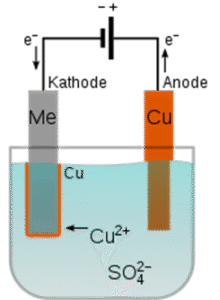
An electric current goes from the cathode (ME) to the anode (CU).
The metal ions (in this case copper) follow the opposite path, thus covering the cathode with the ions, thus encapsulating it.
This process is ideally suited to compare it with the actual purpose of the alchemist, more on that later.
The Anode could be translated as an ODE to the ANimal-state. The cathode as the death (THODE) of the Soul (KA or Ca). In essence, the confinement of the soul, preventing it from expressing itself.
It might cause some confusion when looking up these terms in the etymologic dictionary, because in those days people THOUGHT that the activity was different. It is important that we do not limit ourselves to the event in the electrolytic bath, according to the interpretation of the author of this article.
This leads to the following comparison. When the soul (cathode or kathode) is focused on the animal-like state, the soul is being encapsulated. Perhaps it is clearer to say that, when the soul of the personality is focused on the animal-like state, or also called the ordinary-natural state, it is impossible for the Ka or CA to express itself.
The more impure the anode (lead), the more impure the focus, the faster, the stronger, the encapsulation will be.
Here we need to delve a bit deeper as to the high objective of the serious alchemist, who was striving for transmutation and transfiguration.
A human being who completely and automatically lives from and out of this nature which is ours, is therefore completely one with this nature. This is not necessarily negative. There are, according to our social/humanistic standards, very good people on this earth.
However, for the alchemists there was a different world, a world from a different dimension than ours.
Those worlds differed from each other as …. lead and gold.
Gold was moreover regarded as crystallized Spirit.
The other world, the world of the Spirit, therefore had a golden lustre. It is that lustre that the true alchemists try to accomplish.
It was therefore assumed that the appearance should have a golden glow, so attempts were made to convert this leaden radiance into a golden radiance through a ‘process’
Hence the misconception that the alchemists endeavoured to create a golden metal from lead as material metal.
No doubt there will have been certain persons who have used the naivety of authorities to live a life of luxury and to present from time to time a ‘hopeful’ development, in order to free some goodwill again from their sponsors. Goodwill to be translated as financial means.
Gold, not of this world
What more does the chemistry of galvanizing teach us?
We saw that when the personally exclusively focusses on this nature, it is impossible for the new soul to manifest itself, but it is as it were encapsulated. The silent voice of the original can then not be heard. This can go on for incarnation after incarnation, until the moment arrives that the urge to seek becomes so pressing that the personality as it were is forced to start listening to the inner voice, which never stops resounding. However, it is possible to react to that urge by even deeper focussing on nature and its peculiarities.
Eventually the personality will, exhausted of all this seeking and looking, withdraw their attention from the natural and then something logical happens in the galvanic process. There is no longer any attention for the animal-like state, so there is no longer a current from the cathode to the anode. In the context of this perspective, it should be noted that the cathode here has two parts. This dissolves the grown layer again in the electrolyte. The core of the cathode is formed by a gold-radiating atom, entirely in accordance with the seeking human being. The shell surrounding that core will also dissolve in the electrolyte. The gold-radiating atom is thus completely freed from its constraints. This ties in beautifully with the saying: ‘To make gold, you must have gold.’
The soul is liberated again, referred to in the Gospel as the birth of the child Jesus. It will be clear that this ‘child’ still is in need of the necessary care. Within the galvanic context the cathode is then placed in a chemical gold bath, the anodes of which are formed by carbon sheets.
Carbon as a symbol of the nature of death. Then, one no longer cherishes this nature. In this bath the gold is admitted from outside, as dissolved gold crystals.
When a direct current now emanates from the cathode, that is: the steady desire, those gold ions come down on the Cathode, thus the golden glow of the Ca is intensified. After some time the carbon sheets will split. In the words of the Gospel: the veil is torn.
The nature of death has now completely lost its attractiveness to the personality. The cathode, the Ca, is then sufficiently independent to go its own path. The human being has fulfilled his or her task.
Thus the ancient quest of the alchemists teaches us, translated into modern language, that it was far more than searching for a method to turn lead into gold. It was and still is searching for an answer on the inner urge of the remnant of a soul, Ca, who once was the Soul of the original human being.
The original human being, then seen as a form of consciousness, is impossible to describe in our present state of consciousness. Thus, the alchemy of medieval times is still very modern.
To us the task to end the form of the ode to the animal-state, in whatever form, and continue to a life state in which the Ca is no longer in a sleep of death, but able to revivify again its original soul.
Obviously this is a procedural event. Becoming less apt to the own inner nature and so creating an opportunity for the other One within man, and to attire the other One with a golden glow, not of this world.
[1] Proton emission in ultraperipheral Pb-Pb collisions at TeV | Phys. Rev. C


