Waking up, I feel the unity of all life with a great, completely new awareness, with amazement, connectedness, and love.
The limitations of my thinking and feeling have receded; everything seems to be one, even though diversity exists at the same time. Peace, joy, and love determine my state of mind.
Queues at the temple
It is full moon, and I pause on my hike in front of a temple where long queues of believers have formed. The pilgrims have brought offering plates filled with flowers, fruits, candles, and spices which they desire to present to the temple deity, with wishes of all kinds: success in their careers, in their families, with friends, health, etc. “The deity in heaven will hear us.”
This gives me pause for thought: all these wishes and expectations are forces, subtle matter, energies that will be answered, either through fulfilment or rejection. But do these answers come from “heaven”? What and where is “heaven”? I see the believers and can almost physically feel and see the different expectations expressed in their prayers, offerings, and blessings, their hopes, implored solutions to problems, and much more.
After the sacrifice, the believers turn away from the statue of their god, their deity, and donate a smaller or larger sum of money to the “serving” Brahmin. All of them? Yes, it appears so. They move on, past the line of beggars, some of whom are begging for alms with outstretched hands.
I remember a church promise given in Europe several hundred years ago: “When money clinks in the box, the soul leaps into heaven.” People wanted to buy their way out of sin. What do believers expect from their visits to temples, churches, or mosques? Happiness, success, wealth, spiritual enlightenment, ascension to heaven? Does heaven open up to them?
Thoughts while hiking
I walk on, out into nature, into the forest. Silence surrounds me, interrupted only by the chirping of birds and the rustling of leaves. Where am I? Do I also pray/ask for things of this world?
Words from the Bible come to mind:
And when you pray, you shall not be like the hypocrites, who love to stand and pray in the synagogues and on the street corners, so that others may see them. Truly, I say to you, they have already received their reward. But when you pray, go into your room and shut the door and pray to your Father who is in heaven[1].
I sit down on a bench, my thoughts calm down, and in my mind’s eye I see the queue at the temple once again. Are the sacrifices and prayers in the temple comparable to what the Bible says? How and with what intention do we pray “in our inner room”?
In the Bhagavad Gita, Arjuna asks Krishna to reveal himself in his true form so that he can truly recognise him. Krishna grants him this wish having already imparted much divine wisdom to him. He opens Arjuna’s eye of intuition, and Arjuna sees Krishna in his cosmic form: a form full of grace and full of terror. Krishna explains to him:
Neither through the Vedas, nor through sacrifices, nor through study, nor through gifts, nor through rites, nor through strict asceticism can I be seen in this form by anyone other than you in the human world.[2]
The statement “pray to your Father who is in heaven” wants to show us a way, a way that we can or should follow, a way out of the entanglements of our being in this world, a way to an unknown unity, connectedness with the Father, with God. Krishna warns us that no sacrifices or rituals lead to the realisation of his true nature. I am touched by the words in the Gospel of John: ‘My kingdom is not of this world’. It seems to me that this is in accordance with Krishna’s instructions.
Calmly and without judgment, I try to organise my thoughts. A peace, a love that transcends all understanding, comes over me. A verse from a Rosicrucian text comes to mind:
In the original order of God, love is not a quality […], but a totality.
I remain in this calm state. For how long? Five minutes, an hour, I don’t know. Eventually, I move on. I perceive my surroundings, the forest, the trees, the moss, the rustling of the dry leaves, and the chirping of the birds differently, more intensely, and more beautifully. I feel a unity and connection with all of nature. I feel the thoughts and ideas within me, but with a distance: the experience of unity with nature extends further, much further. Is this a glimpse of another dimension, a heaven that is not of this world?
Tea house
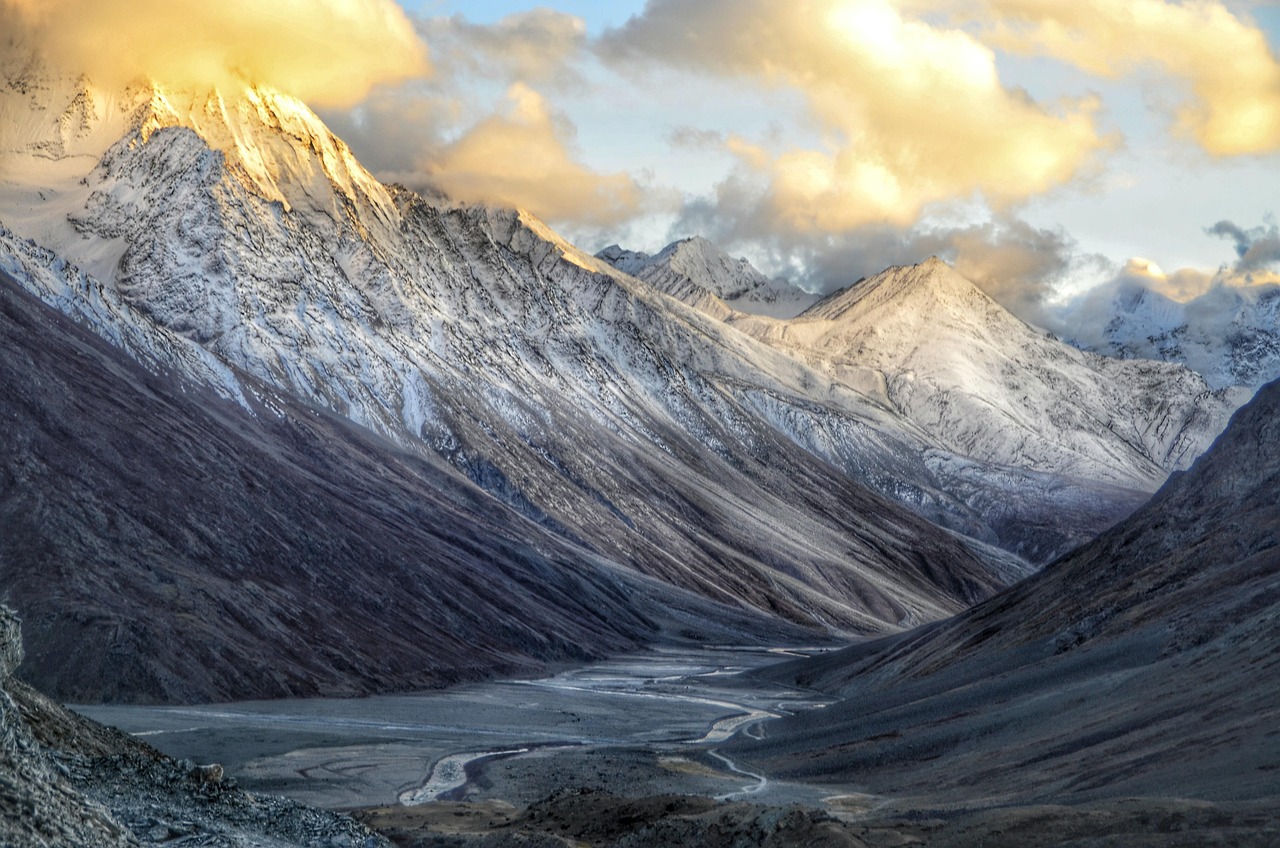
The path leads out of the forest into an open field, and I stand before the majestically towering Himalayan peaks, their snow-covered tops glistening in the afternoon sun. I feel the titanic forces that once pushed these mountains together and raised them thousands of meters high. For the locals, these peaks are the seats of the gods to whom they make sacrifices, from whom they expect help and strength … What do these mountain peaks say to me?
The path continues steeply down into a valley and the village that is the destination of my journey today. I walk towards it. The friendly welcome, the flower garlands on the door, the welcome tea—I take it all in as if in a dream, join in the pleasant conversations, but inside I am far away …
After dinner, I retire early to a simple room, lie down on the cot that will be my bed for tonight, and see the images of the day before me. I remember a picture I saw in one of the Rosicrucian books: a wanderer, half-reclining, looks out from his world into a new, unknown one. Amazed and delighted, he sees an infinite universe. The lower part of the picture shows our familiar world, which is covered by a dome and separated from the endless universe by a band of planets, stars, and moons. This band separates our world, the world we know, from the upper part of the picture, where another dimension opens up, another world. The wanderer in the picture crouches on the ground of this world, but his head penetrates the band of celestial bodies, reaching beyond it into the higher dimension. Does he see and experience the „new earth“ and the „new heaven“, as it says in Revelation 21:1-2? A heaven, a world that extends beyond the known world, that surrounds and delimits it, or even encloses it? Jakob Boehme’s statement about the divine primordial substance comes to mind. The divine qualities that work within it separate from their original unified state. An enclosed space, our world, is created in which living beings can develop their specific nature in freedom.[3]
With this image in mind, I fall asleep.[4]
Breakfast
Waking up, I don’t remember my dreams, but I see the world through different eyes. The bright morning, the glittering snow-capped mountains, the simple and peaceful surroundings, everything is as usual, yet something inside me seems to have changed. What is it? I feel the unity of all life with a great, completely new awareness, with amazement, connectedness, and love. The limitations of my thinking and feeling have receded; everything seems to be one, even though diversity exists at the same time. Peace, joy, and love determine my state of mind. Is this a glimpse into the open other world, as the artist tried to depict in the engraving I mentioned? The many explanations I have read swirl through my head; I perceive them, but they do not touch me.
My friendly hosts address me and invite me to a simple breakfast. We talk about everyday things. But the conversation takes a turn when the host talks about his experiences in Europe: Don’t we all, in our own way, seek to understand nature and life, and to overcome suffering and death? He explains the four sacred truths of Buddhism to me in simple terms and emphasises that the Nirvana of the Buddhists, or the Heaven of the Christians, is open to all! We only need to recognise this and understand the relativity and limitations of the world. Unfortunately, we are still too attached to this world, its joys and its problems, and are not open to recognising the other world — call it nirvana or heaven. He quotes passages from the Bible and a Buddhist scripture.
John says in Revelation: And I saw a new heaven and a new earth; for the first heaven and the first earth had passed away, and the sea was no more. And I saw the holy city, New Jerusalem, coming down out of heaven from God.[5]
And in Buddhist scriptures, we read that Buddha’s nirvana is the highest state of liberation, peace, and freedom from suffering (dukkha) and the cycle of rebirth (samsara), achieved by extinguishing the fires of greed, hatred, and ignorance. It is not a physical place, but a profound state of being and wisdom.
After these statements, we remain silent and lost in our thoughts. After some time, the host rises and says goodbye. He wishes me deep insight.
[1] Matthew 6:5
[2] BhagavadGitainGermanLanguage.pdf Bhagavad Gita 11:48
[3] Das Mysterium Magnum (Interpretation der Genesis)- Jacob Böhme – Gesamtausgabe – Deutsche Überarbeitung
[4]Wikipedia: Flammarion’s wood engraving, also known as Wanderer at the Edge of the World or, in French, au pélerin (“on pilgrimage”), is the work of an unknown artist. The wood engraving first appeared in 1888 as an illustration in the subchapter La forme du ciel (“The Shape of the Sky”) of the popular science volume L’atmosphère. Météorologie populaire (“The Atmosphere. Popular Meteorology“) by the French author, astronomer, and president of the Société astronomique de France, Camille Flammarion, who founded the society in 1887.
[5] Revelation 21:1-2