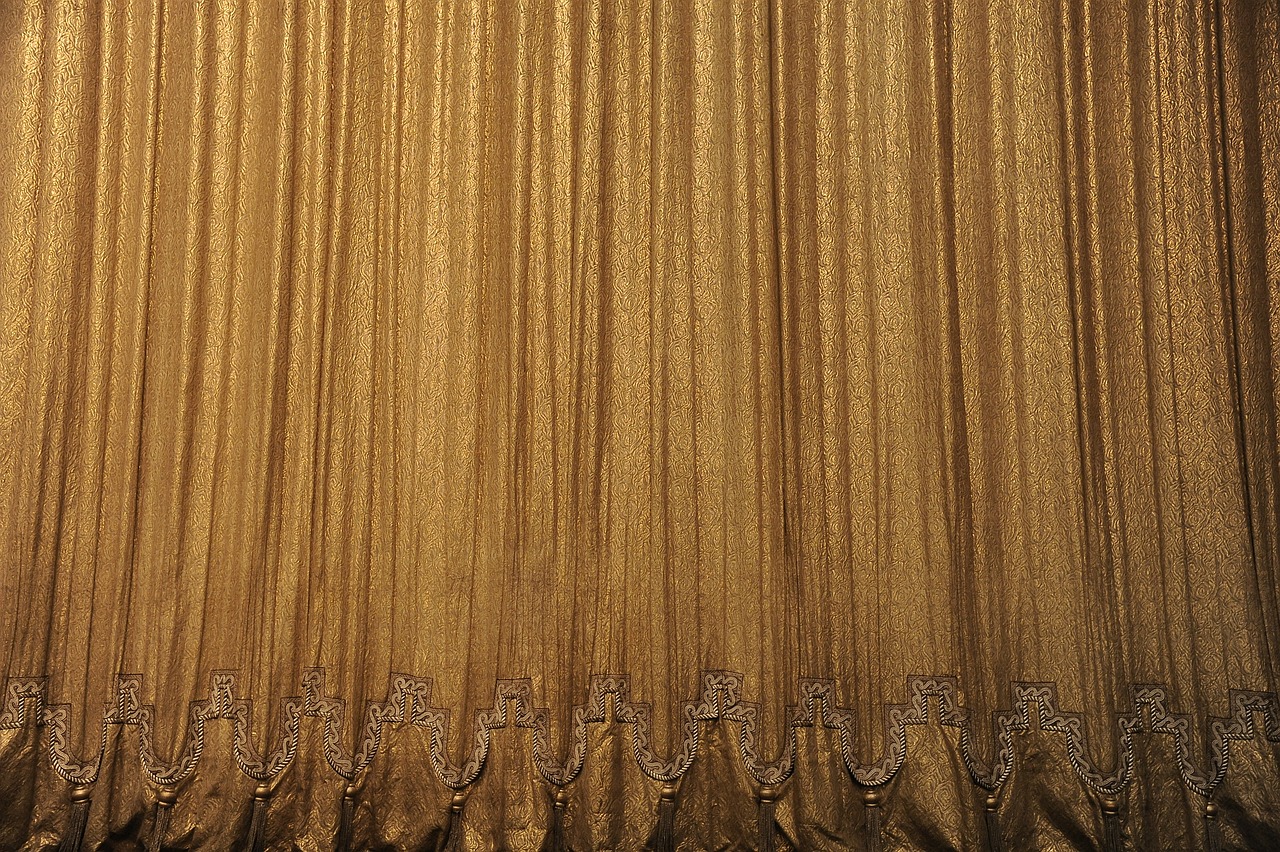
Can we see things (and the world) as they (really) are – and not as we imagine them to be? Can we push aside our veils?
There are no secrets as such, only the uninitiated of all degrees.
There is hardly a simpler way to say what life is all about than in this sentence by Christian Morgenstern: It is not the truth that is complicated, but our inability to penetrate its simplicity. We are the ones who get lost in diversity. We cannot discern the truth because we are unable to set aside our own points of view and projections. We lack awareness. So, all our brooding only ever results in duplicating what we already know and think.
However, is it even possible to simply pull aside the curtain in front of the simple truth when we love this curtain, cling to it, decorate it, make it heavier, and possibly even be part of the curtain ourselves? There is no doubt that it is not that simple; we would need a method, a trick to outwit our own limitations. That sounds like one of the stories of Baron von Münchhausen, who was able to pull himself out of the mire by his own bootstraps.
But even if we are at a loss before the curtain, it is worth looking for a way to open it. It is not the “simple life”; it is not limiting our thinking or feelings; and it is not meditating into the unknown nor leaving behind what we hold dear. None of this would help us.
Perhaps we must first get used to the contradiction that all phenomena only appear to be true, but the truth is nevertheless accessible. What we generally understand by objectification or “objectively” means basically nothing other than turning all things into objects, into objects of our perception, into wagons in our ego’s railway station, which constructs exactly what we ourselves want to see, pretending that this oscillating diversity is already the origin. From the outside, we are confronted by our own, which is mirrored many times over. As upsetting as this observation can be, it is also beneficial because the search is worth it.
Lao Tzu called the simple truth Tao, and repeatedly said that this Tao is the source of everything, but is incomprehensible. Inconceivable for whom? For all people? For the Morgenstern’s “uninitiated”? Many people have listened to Lao Tzu’s texts hundreds of times, and they may have enjoyed them. That is not a bad thing. But it is obviously not enough to lift the curtain on the simple truth.
Let’s take a closer look at the Chinese version of the word curtain:
There is a famous passage in the Tao Te Ching, which appears several times. The most common reference is to chapter 25, where the last line reads: “Dao Fa Zi Ran“. A Chinese friend once translated these words for me very simply as “Tao is the law of nature“. He apparently meant well and didn’t want to irritate me. And he added, “It’s as simple as that”.
Fa means “method”, “way of doing something” or simply “law”.
But aren’t we making it too easy for ourselves if we only translate Zi Ran as “nature”? Because the term, like many others in the Chinese language, has a variety of meanings on several levels. And this is where the “ten thousand phenomena” that emerge from the One begin – and end with our curtain.
Zi Ran doesn’t just mean “nature”, but also “natural”, “simple”, “original”, “lightness”, “free from affection” or “the-from-itself-emerging”, and so on….
We could consider what nature might mean by the term Zi Ran. Probably not just the “external” nature that humans share with other living beings. But which one then? The dazzling variety of translations does not make things any easier.
Let us therefore return to Morgenstern for a moment: We can assume that Morgenstern’s “initiate” sees things (and the world) as they (really) are – and not as he imagines them to be. Initiation then means pushing aside one’s own veils. Non-initiation is decorating these veils.
Apart from the fact that Lao Tzu’s words are often cryptic and difficult to understand, we sense their depth. Taken seriously, they become a shock that shakes up our being and confuses our minds. Wouldn’t pushing aside the veils also mean pushing aside our own being, which constitutes our identity? We would be turning towards a nothingness or the “self-existing” (as Zi Ran is sometimes translated) – and all this “free from affection” as Lao Tzu says! A crazy, unfulfilling request, isn’t it?
It’s obviously about more than taking yourself less seriously, about more than eating and drinking less, talking less and about more than giving up comfort. It is about a different life, not just a higher octave in the known life, but ultimately about a different consciousness that no longer has its centre in itself.
Anyone who works – no matter what – and immerses himself completely in this activity forgets his surroundings and ignores himself. In a certain sense, he is no longer present. Many of us are familiar with this. It is a faint image of what Lao Tzu and Morgenstern are hinting at. But at least it shows that the ability is inherent in man. Those who are inside are initiated precisely because they are no longer just with themselves.
This experience leads us to suspect that, behind (or in) the diversity we are and that surrounds us, there is a nature of a different order, the “being-in-itself”.
Recognising this could be the first step; it takes some effort, but with it, we leave the auditorium and pluck a little at the curtain of confusing diversity.
Letting yourself be touched by it is the second step; it takes more courage and more effort; with it, we open a narrow gap in the curtain; we see the first contours and hear the music behind it, and begin to change.
And with the third step, we pull the curtain completely aside. This is certainly the decisive and most difficult step. It demands everything from us.
But for all three steps, we have to go on stage physically, the stage of our lives. We cannot escape this effort, because if we are stuck in our seats in the stalls, nothing will ever change.
This is how we move through all of Morgenstern’s “degrees of the uninitiated”.
When we then open the curtain, we realise: Behind it is – NOTHING.
Nothing, and yet EVERYTHING. Nothing that we know or can imagine. And yet it permeates everything.