Beauty is not just a feast for the eyes. Beauty is a promise. The fact that beauty exists makes us trust in that which keeps the world together.
Beauty that the eye sees may remind the soul of something. Sometimes it is like an awakening, sometimes it can even be a cure.
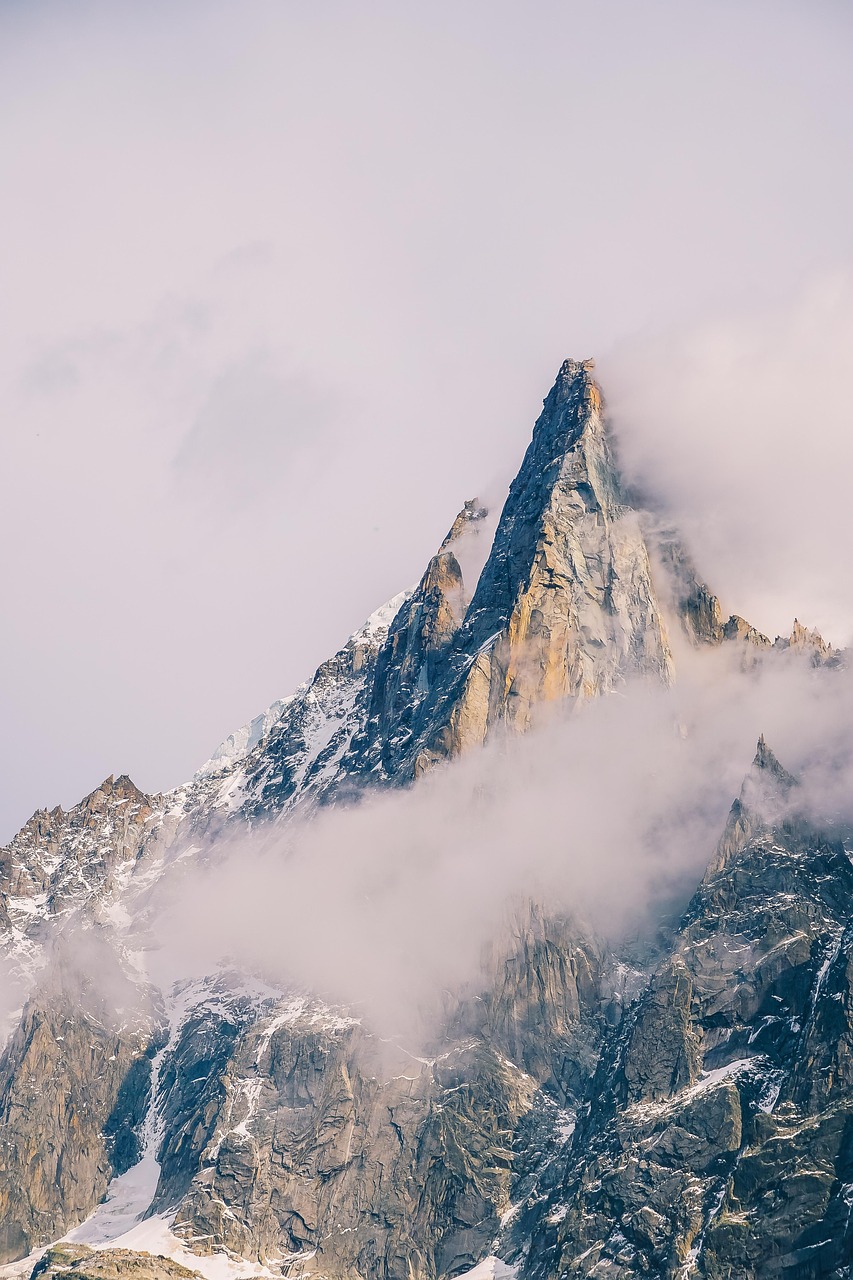
Why do I think the mountain I’m looking at is sublime? I am one of those people who don’t necessarily want to climb the mountain. I would rather be the mountain. Maybe I actually am. Because the rocky triangle that arises from the plain and culminates in a point that is not only close to the sky, but that merges into it, as it were, despite the contrast between the heaviness of the rock and the lightness of the air: it resembles my own nature. It reflects that in me which looks upwards, which wants to rise up and change to another state of being; that which, having reached the summit of my earthly existence, at least wants to expose itself to „this other“, again and again. That is what touches my heart when I come face to face with a beautiful mountain.
Something from the depths of artistic beauty
Islamic artists have created patterns consisting of a few regular geometric shapes, mostly stars, which can be continued endlessly due to the perfect coordination of the shapes with each other. When you look at them, you get the impression that they fill the entire firmament. They are actually based on the idea that number, proportion and form are the key to the structure of the cosmos. These patterns connect the multitude and the One through mathematical relationships; according to this way of thinking, they open up inwardly to the infinite, to the ultimate reality, which is the source of all things.
The mathematical point, which neither spans a surface nor occupies space, represents an original spiritual principle. When this point touches our sphere, it draws a circle around itself like a drop falling into a lake. It generates vibrations and makes contact with its surroundings. In such a creation process, circles touch and penetrate each other. It is easy to imagine that in their interaction they also form star patterns as the Muslim artists have made them visible. At the same time, these patterns point to the One who emitted everything and draws it back into himself. They are a coming into being, flashing up and disappearing again – a round dance that fills the whole universe.
What Does The Soul See?
Our eyes are drawn to that which our soul seeks. When we consider shapes to be beautiful, it is not just because they are proportioned in whole-number ratios or the golden ratio. We seek – and see – more than “mathematical harmony” or “order”. We see that everything is connected. The number or proportion is an external characteristic of resonance.
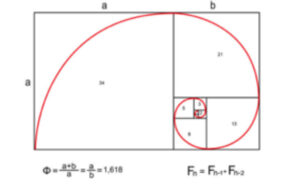
The golden ratio is perhaps the clearest illustration thereof. This rule (which also produces the Fibunacci series) means that the shorter of two distances must relate to the longer as the longer to the sum of the two distances. This corresponds to a numerical ratio of 1:1.618… . Or to put it another way, more clearly: the whole is divided further and further and is reflected in the resulting parts. This numerical ratio clearly connects the smallest and the largest in nature.
 Beauty or harmony is found in that which makes a complex form into a unity and in that which connects all things. We feel a sense of meaning. If beauty and connectedness are to be not just a feeling but a truth, then that which holds things together must also exist in power, in interactions, in a flow from the innermost to the outermost and back again.
The sides of a pentagram intersect each other in the golden ratio. An ideally proportioned person has the golden ratio within them. If you divide their body height accordingly, you end up at the navel. If a person stretches their hand upwards, their fingertips are twice the height of their navel. The architect Le Corbusier used these measurements, based on a person with a height of 6 feet, as the starting point for his Modulor series, which he used to proportion his buildings. The navel height, divided by the golden ratio, results in an ideal table height. Divided again, an ideal seat height. Le Corbusier also used the golden ratio to find room heights and window dimensions. Everything then bears human scale, people thus resonate – with the whole. “By means of the forms [the architect] intensely touches our senses and awakens our feeling for the design. The connections he creates resonate deeply with us, he shows us the scale for an order that is perceived as being in harmony with the world order.“[1]
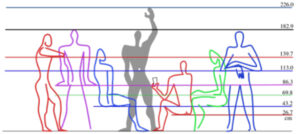
Showing no modesty, this is how Le Corbusier saw it. What he writes here raises the question of whether everything is on a human scale. Or can we see here an indication of an all-connectedness in the midst of which man finds himself and which he can perceive and recognize – experience – through resonance?
Beauty isn’t just beautiful
Apart from the fact that most people like to surround themselves with beauty, partly for the reassurance that everything is fine or will be fine, beauty allows us to make contact with that which holds our cosmos together. It becomes obvious in balanced form and connective proportion. But there is more. It points to a unifying meaning that not only gives us ontological security. There can also be something awakening, stirring, enabling and sometimes challenging in it.
Rainer Maria Rilke stated in his Archaic Torso of Apollo (1908) that the beauty we see looks back: “for there is no place that does not see you. You must change your life.” Beauty is not just a feast for the eyes. It challenges us to perfect ourselves in order to become like it. Now you can tighten the screws of self-optimization. But you can also sense that something inside you is able and willing to rise up in response to the beauty you perceive.
You can also learn to perceive the spiritual space in which the many encounter each other, encounter themselves and ultimately also encounter the One, the Groundless and Creation as a real unity in which everything interacts and relates to each other. In his 1914 poem Es winkt zu Fühlung (It beckons to feel), Rilke captured the inclusion of the world in the space of the soul and the soul’s simultaneous becoming world-wide in the term Weltinnenraum, which is rightly experiencing a renaissance. Inside and outside become one for the looking soul.
[…] Durch alle Wesen reicht der eine Raum:
Weltinnenraum. Die Vögel fliegen still
durch uns hindurch. O, der ich wachsen will,
ich seh hinaus, und in mir wächst der Baum. […][2]
[…] That only space, it penetrates all beings:
World’s inner space. Silently birds are flying
right through ourselves. And I, wanting to grow,
I look outside, and inside me grows the tree. […][3]
The harmony within me nourishes creation. What I see outside turns into symbols that show my soul who it is. The things of the world can even become landmarks of spiritual processes – those that are happening and those that are possible.
“The soul is an eye in the eternal unfathomable: a likeness of eternity “[4], says Jakob Böhme. At the same time: “The whole body with all its parts signifieth heaven and earth.”[5] Anyone who studies Böhme’s mystical philosophy will notice that it describes the divine abyss and the human soul first and foremost as an eye. A duality is created here, a divine-human tool of knowledge. Furthermore, the Holy Spirit, nature and man are reflected in each other, they are parables for each other. (And parables are not explanations or stories, but signify deep congruence and enlightening knowledge). In all of this, Böhme attempts to describe an overwhelming unity that transcends all understanding, in which the great and the small behold, recognize and correspond to one another, in which they are one life. We can awaken to this realization and this co-movement. If the eternal is one, it is beautiful. Must not the fabric of the world then also be beautiful, and the human being in it?
The world with its events is our teacher. Every day it gives us the parables of the All-Being as an illustration. It also shows us when we are not in harmony with it, which also means that we are not in harmony with our own deepest being. Have you ever experienced that an awkwardness, an accident, an illness has brought about a clarity in you, an inner encounter between your realized self and the true self within you? That in the upheaval the spirit soul became free to show itself for this one illuminating, perhaps healing moment? Was there strength and beauty in this moment, despite everything?
God, world and man form one fabric, one life. Nevertheless, we also lead a kind of shadowy existence in it. Sometimes beauty is revealed and our souls rise up to return to the source. Sometimes they become afraid of true oneness. But the light of the one who wants to show himself convinces us again and again. If the soul is in the light, then everything is filled with light, even matter.
For further reading:
- Keith Chritchley: Islamic Patterns. An Analytical and Cosmological Approach, Rochester 1999
- William H. Chittick: The Sufi Path of Knowledge. Ibn al-‘Arabi’s Metaphysics of Imagination, New York 1989
[1] Le Corbusier: Ausblick auf eine Architektur, Berlin – Frankfurt am Main – Wien 1963, S. 21. MY OWN TRANSLATION
[2] Here the fourth verse of the poem
[3] Es winkt zu Fühlung fast aus allen Dingen – Rainer Maria Rilke Diskussionforum – found on feb 21, 2025
[4] in: Das umgewandte Auge, in: Jakob Böhmes Schriften, Leipzig 1935, S. 298: Please look up an official translation!
[5] in: Aurora or Day-Spring, p. 70, Electronic Text Edition, 2009, in: Jacob Boehme’s Aurora – electronic text-edition : Jacob Boehme (Jakob Böhme) : Free Download, Borrow, and Streaming : Internet Archive