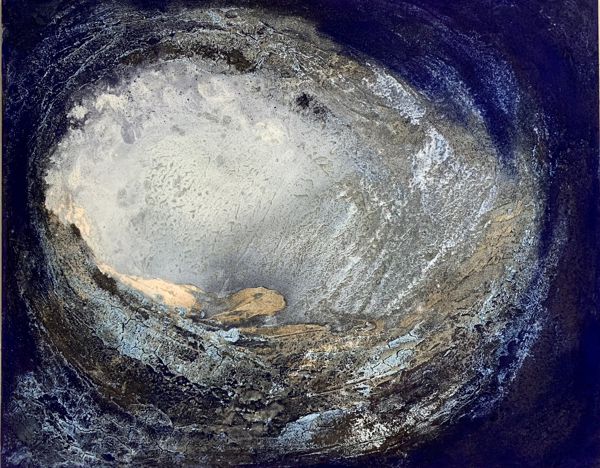
The spiritual development that humanity is facing leads from faith to higher knowledge.
It implies a transformation of consciousness that is more than an expansion of the consciousness the path began with. However, the transformation leads into and through emptiness, through not-knowing.
At all times, spiritual teachings have provided us with knowledge of developments and higher states of being that are inherent within us. Whoever is touchable not only absorbs “second-hand” knowledge, but sometimes experiences a touch that opens up concrete inner knowledge that resembles recognition. This is why the Rosicrucians speak of breaking open the primordial knowledge. It is this inner knowledge that can also be described as gnosis. But gnosis is not only knowledge, it is also love and power: it is the vehicle of a living process of renewal.
Our ego consciousness always fails to do justice to this vitality when it wants to stockpile knowledge – even if it follows the logical idea that the thus acquired knowledge can and should continue to expand, deepen and differentiate within our own consciousness until it literally becomes a knowledge of everything . But holding on to it sooner or later closes off the source of living wisdom. That which is alive and recognized as truth becomes brittle, lifeless, even boring. One may begin to doubt it. (Or to condense it into a dogma and to keep the knowledge alive, so to speak, with the fire of self-will, as far as it is still alive then…)
When the aforementioned source which makes gnosis fruitful as a universal potential is opened within us, then power that is intended to bring the inner human being back to life flows towards us. The ego, which treats power and knowledge – unintentionally – as its own property, intervenes, as it were, and thus repeatedly closes off the source from which alone living knowledge flows. And it should flow into our entire being and life. If the heart closes itself off, then the experienced connection with the source, which is actually light (and therefore knowledge), comes to an end.
When the stream dries up, we learn that we cannot willingly get it going again. We want to be touched again, but we cannot attract the gnosis. We can do nothing but become still and open. We have to admit to ourselves that we do not have power and knowledge at our disposal. Standing there unknowing and empty-handed makes us touchable again, because for a moment – perhaps still unconsciously – we have relinquished control.
The inner self that is still hidden cannot act concretely in us at the beginning, but gnosis as an all-encompassing principle of power can touch us, uplift us, nourish us and make us realize more and more that only through devotion can we walk the path, clear the way for the true being within us. The heart that perseveres in silence and opens itself demonstrates faith; it can receive in ignorance, in simplicity as it were.
Thus a renewing stream of power arrives anew, conveying greater and deeper knowledge… and so at some point the ego reaches out again for this beauty, this vastness, this knowledge, in order to build a better ego, only to discover again that the living stream has dried up.
This cycle of faith, knowledge and the passage through emptiness entails a process of reciprocal construction of the new and deconstruction of the old. Our whole being is purified, it learns to let go, eventually even of the previous self. The insight associated with these experiences seems more or less useless, but it is essential for the path. Lao Tse describes some of it in chapter 20 of the Tao Te King:
Give up learning, and put an end to your troubles. […]
Others have more than they need, but I alone have nothing.
I am a fool. Oh, yes! I am confused.
Other men are clear and bright,
But I alone am dim and weak.
Other men are sharp and clever,
But I alone am dull and stupid.
Oh, I drift like the waves of the sea.
Without direction, like the restless wind.
Everyone else is busy,
But I alone am aimless and depressed.
I am different.
I am nourished by the great mother.[1]
On the path, external knowledge, acumen and external goals lose their power and significance. In the earthly course of things, such a person seems lost, for he surrenders to the course of destiny – and to the intuition he receives from his mother, the gnosis. He himself makes no plans; he makes room for that which wants to flow in and reveal itself. He lives in a silent connectedness without expectations. Sometimes he may feel worthless, but his courage lies in his surrender to this incalculable process. That is why he can say: “I am different.”
In the emptiness, our concepts, our desires and the tools we have been using to navigate life up until then come to nothing. How can we become empty? Actually not at all – emptiness is the opposite of our existence; it only occurs when all our striving and doing… comes to an end and there is nothing left for us to do, want, think, wish or fear at the moment. We experience an end that is a new beginning. The spring opens up again.
Realizing that the universal within us can reveal itself through not-knowing and even non-being of the ego deepens further and further on the path. It becomes a conscious state of being. The fact that the path to truly comprehensive inner knowledge passes through emptiness is significant: for the new consciousness that arises as a result is an expression of all-connectedness and unity, it is in no way a repository of knowledge, of whatever sublime kind. In the course of this development, the focus of consciousness shifts from the ego to the inner self, our universal self.
Thus the process of faith, connection, knowledge and passage through not-knowing and ultimately non-being transitions into a new being. In the universal self, the cycle becomes a living, balanced trinity. Emptiness reveals itself as both the deepest self and the source of everything, faith unfolds into all-connectedness and all-love. Deep wisdom, which knows and embraces everything, flows from all-connectedness, which is true unity.
[1] Translation by Gia Fu Feng und Jane English, Tao Te Ching – Lao Tzu – chapter 20 downloaded on 9 november 2024