Psyche: The Three Phases of Inner Transformation
I The Caterpillar and the Story of the Fennel
Once upon a time, by the side of a path where the grass smelt of sunshine, there stood a tall fennel plant, waving its green, feathery fronds in the morning breeze. On one of these fronds lived a tiny caterpillar, striped in green and black and dotted with orange spots: like minuscule glowing embers. Humans would later call it a swallowtail—Eatalot for our purpose—but caterpillars have no names, and this one was content simply to exist.
Its world spanned the distance between a root and an umbel of flowers. It knew only three things: the fennel, the dew, and the warm earth, onto which it would slide down to sleep. It spent its days eating, and its nights dreaming of eating even more. It did not see the sky; to the caterpillar, the sky was merely a distant warmth resting upon its back, like the hand of an invisible grandmother.
“Eat, grow, crawl,” its little body urged. And it obeyed, with the simple wisdom of creatures who know nothing else.
Yet, one morning, something strange occurred. A sharp, pungent scent drifted through the air—a smell unlike the dew or the fennel, reminiscent of varnish and sparks. In that same instant, a tiny, stinging sensation shot through the caterpillar—as vivid as a bolt of lightning no larger than a grain of sand. It writhed, bewildered, and scurried to hide beneath a leaf.
The next day, the scent returned, as did the stinging sensation. And the day after that, it happened again. And so, Eatalot learned. From then on, the moment that scent brushed the air, she would curl up, turn her back on the danger, and crawl to the other side of the path. It was her first true lesson, and she etched it deep within her little head—in that place where one keeps what truly matters.
Days passed. Eatalot grew and shed her skin—once, twice, three times, four times. Each time, she feared she might die, for her old coat had grown too tight and was splitting apart; yet, each time, she emerged larger, more vibrant, and a little wiser. The young caterpillars nearby watched her with admiration. But they did not know that only those who have lived much, eaten much, and trembled much can pass on their lessons to those who will come after them.
Then, one late summer evening, Eatalot realised that the fennel no longer held any flavour. Even the tenderest leaves tasted bland, and the earth—once so welcoming—now felt confining. Something within her, beyond her own control, began to turn upward. For the first time in her life, she lifted her head and beheld the sky: vast, golden, and traversed by wings that never came to rest.
That evening, a great, golden shadow alighted upon the fennel. It was a swallowtail butterfly with amber wings, edged in the darkness of night and adorned with a small, red-and-blue eyespot. It placed a tiny egg upon a leaf, then turned toward the caterpillar with infinite gentleness. “Little sister,” it said, “do not fear what is to come. I, too, once crawled upon this very stem. I, too, trembled at that same scent. Everything you have learned here, you shall carry with you—even if it feels as though you are losing everything.” » Then he flew off, and the caterpillar remained for a long time, gazing at the spot where he had vanished.
“I do not know what awaits me,” she whispered, “but I can no longer remain who I am.”
So, she climbed up a stem, spun a silken thread around herself, clung to it with all her might, and, in the profound silence of the evening, she closed her eyes.
II Nature’s Mirror – Karl von Eckartshausen and the Parable of the Butterfly
You, the reader, have likely smiled at this caterpillar. Yet, look at her more closely: do you not recognise what this signifies? Karl von Eckartshausen—an 18th-century Bavarian mystic and author of ‘The Cloud upon the Sanctuary’—viewed nature as an open book, penned by the same hand that fashioned the human soul. Every creature within it is a letter, and the metamorphosis of insects constitutes one of the clearest sentences in this alphabet. In the spirit of his writings, the butterfly serves as a living parable, one whose three chapters can be read.
Eckartshausen discerned two beings within each of us: one external, oriented toward forms, needs, and appearances; the other internal—hidden like a germ beneath the bark—which only transformation can bring to fruition. The former is the caterpillar; the latter is the butterfly already dwelling within it, much as the outline of a wing might be glimpsed beneath the taut skin of a larva. Thus, the spiritual life adds nothing to a human being; rather, it liberates what is already carried within.
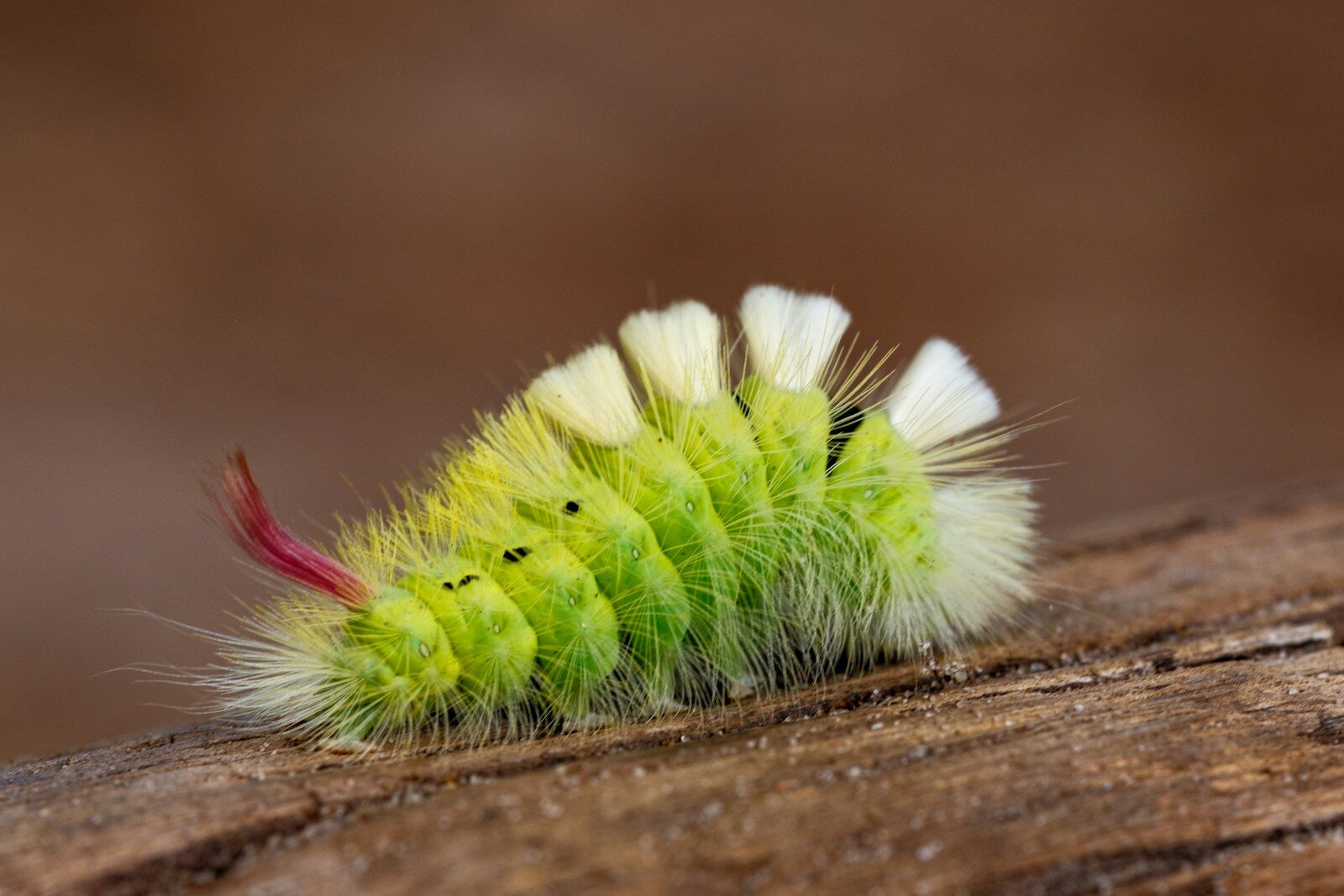
The caterpillar represents natural man. He lives close to the earth, nourished by his senses, and knows only what he touches and what he eats. He is not evil: he is asleep. He believes that the world ends at the edge of his leaf. Yet, as in the case of the swallowtail butterfly, a germ of a different nature lies dormant within him, and a day comes when food no longer satisfies him.
The chrysalis is a state of apparent death. Nothing resembles a tomb more closely, and nothing is more living. Inside, the caterpillar does not disappear; it dissolves, only to be recomposed. Its former forms fall away, and a new being—one the caterpillar could never have imagined—takes shape in secret. This is the moment when a person lets go of the self they once were, without yet knowing who they will become.
The butterfly, ultimately, represents the regenerated human being. It no longer feeds on leaves, but on nectar; it no longer crawls, but allows itself to be carried. It now belongs to two worlds: the earth, which it lightly brushes, and the sky, which dwells within it. And it destroys nothing; it moves from flower to flower, unknowingly fertilising them as it goes.
But here is the most beautiful part: in 2008, scientists discovered that a butterfly can retain memories of its life as a caterpillar. A scent that once made a swallowtail butterfly tremble in the grass is still avoided by the adult insect—wings unfurled, weeks after its long slumber—even though its body had once almost entirely liquefied. Nothing the soul has truly learned on earth is lost within the chrysalis. Metamorphosis is not an act of forgetting; it is a transfiguration.
III – The Three Phases of the Great Work – Blackness, Whiteness, Redness
Alchemists translated this parable into the language of their own craft. For Karl von Eckartshausen—who saw in the chemistry of nature an alphabet of the soul—the true “Great Work” was not the creation of a metal, but the transmutation of the human being: the lead of a fallen nature becoming the gold of a regenerated one. In the spirit of these writings, the crucible represents a soul, and the athanor, an entire life. The masters of the art identify three phases, which their texts term *nigredo* (the blackening), *albedo* (the whitening), and *rubedo* (the reddening).
The first is darkness—*nigredo*. Here, the alchemist subjects raw matter to putrefaction, for nothing can rise without first coming undone. In human terms, this is the caterpillar: it eats, it crawls, it learns to flee from the scent of burning, and it sheds its skin—believing, in the process, that it is dying. This is the time when one encounters one’s own shadow: one’s appetites, fears, vanities, and resentments. It is not a pleasant experience, yet nothing about it is useless; for this darkness is not a punishment—it is a diagnosis. It reveals what one is made of, and this is the essential prerequisite for any transformation. One does not dissolve out of self-hatred; rather, one allows oneself to be undone out of love for what one might become.
The second phase is whiteness—the *albedo*. Following putrefaction comes clarity: the blackened, dissolved matter is washed and refined until it turns as white as the dawn. The alchemists spoke of *solve*—”dissolve.” This is the chrysalis, hanging by its silken thread in the silence. Within it, the insect’s body liquefies; old forms fade away, yet nothing of true essence is lost—only that which was coarse falls away. The soul, unburdened of all that weighed it down, becomes as clear as a mirror—finally capable of receiving a light that does not originate from within itself, but stems from another nature entirely. The disciple has nothing left to do but consent to the fire.
There is one more thing—something known as well to old gardeners as it is to alchemists: one must not force a chrysalis. Whoever opens it too soon, out of impatience or curiosity, does not set a butterfly free, but rather releases a mutilated creature with crumpled wings that will never unfold. The fire of the Great Work is slow, and time is a more faithful master than haste.
The third phase is the redness—the *rubedo*—the crowning of the Work. The white ignites: the purified matter takes on the color of the dawn, of blood, and of gold. This is the Stone, the tincture that transmutes. In a human being, it is the butterfly with amber-hued wings, bearing a small red eye upon each wing. Yet, observe the dark border of those wings: the blackness has not been erased; it has been integrated, transformed into a pattern. More than that: the butterfly remembers the very scent that once made the caterpillar tremble. The three phases do not cancel one another out; rather, they nest within each other, like the successive layers of a single life.
For true gold, the sages would say, is not kept in a chest—it is given away. The initiate, having become the Philosopher’s Stone, retains nothing for himself; he transmutes whatever he touches, just as a butterfly flits from flower to flower, fertilising them without even knowing it. *Nigredo*, *albedo*, *rubedo*—three names for a single metamorphosis—of which the caterpillar, the chrysalis, and the butterfly are merely the living faces.
The ancients did not merely describe these three phases; they built them in stone.
IV The Three Temples – The Sanctuary of Eleusis and the Crypts of Egypt
In Greece, at Eleusis—just as in Egypt, at Memphis and Thebes—the tradition of the initiates recounts that the candidate did not merely pass through a single doorway; rather, they traversed three temples, nested together like the petals of a single flower. Listen, and follow them with your gaze.
Here is the first: the Temple of the Earth. You tread upon its forecourt—the place where those who entered what were known as the Lesser Mysteries were welcomed. The columns are massive, dark stone; the air smells of damp earth and ritual water. Inscribed on the threshold are words made famous by Delphi: *Know thyself.* Here, you are washed, questioned, and asked to look your own shadow in the face. Here, the caterpillar crawls. Here, you learn that the earth is not a prison, but a workshop.
Next is the second: the Temple of Night. You descend into it. The steps sink beneath the ground; daylight is left behind like a discarded garment. This is the crypt, the chamber of trials, a sarcophagus open amidst the darkness. Here, you pass through earth, water, fire, and air. You learn to die before you die, so that no death may ever take you by surprise. You lie down; you are alone; you are motionless. You are the chrysalis. And in this silence, with no one else present, something within you dissolves, while something else—something you had never seen before—begins to take shape.
Between the second temple and the third, there was neither door nor staircase—only a narrow passage, which the candidate must traverse on hands and knees, and which each person must cross alone. Those who have experienced it do not speak of it. They say only that, in that moment, time stands still; that fear falls away like an old skin; and that a soft fluttering of wings—which one might have mistaken for the beating of one’s own heart—can be heard.
Then comes the third: the Temple of Light. The doors open onto the dawn. This is the inner sanctuary—the *Adyton*—which no one could describe, for no one could enter it while still carrying their own voice. At Eleusis, the hierophant would silently display a harvested ear of wheat: the grain, buried and seemingly dead, reborn a hundredfold. No explanation, no discourse—only living proof that what descends into the earth rises back toward the heavens.
The Greeks, who possessed such vast knowledge, used a single word for both the soul and the butterfly: *psyche*. They did not choose this word by chance.
And so, we come to understand that these three temples were not merely made of stone. They exist within us: in the caterpillar that carries us, in the chrysalis that awaits us, and in the butterfly that we already are. And somewhere—beside a path where the grass smells of the sun, upon a tall fennel plant swaying its feathery fronds in the breeze—a swallowtail butterfly rests with its wings spread wide in the light, and remembers.