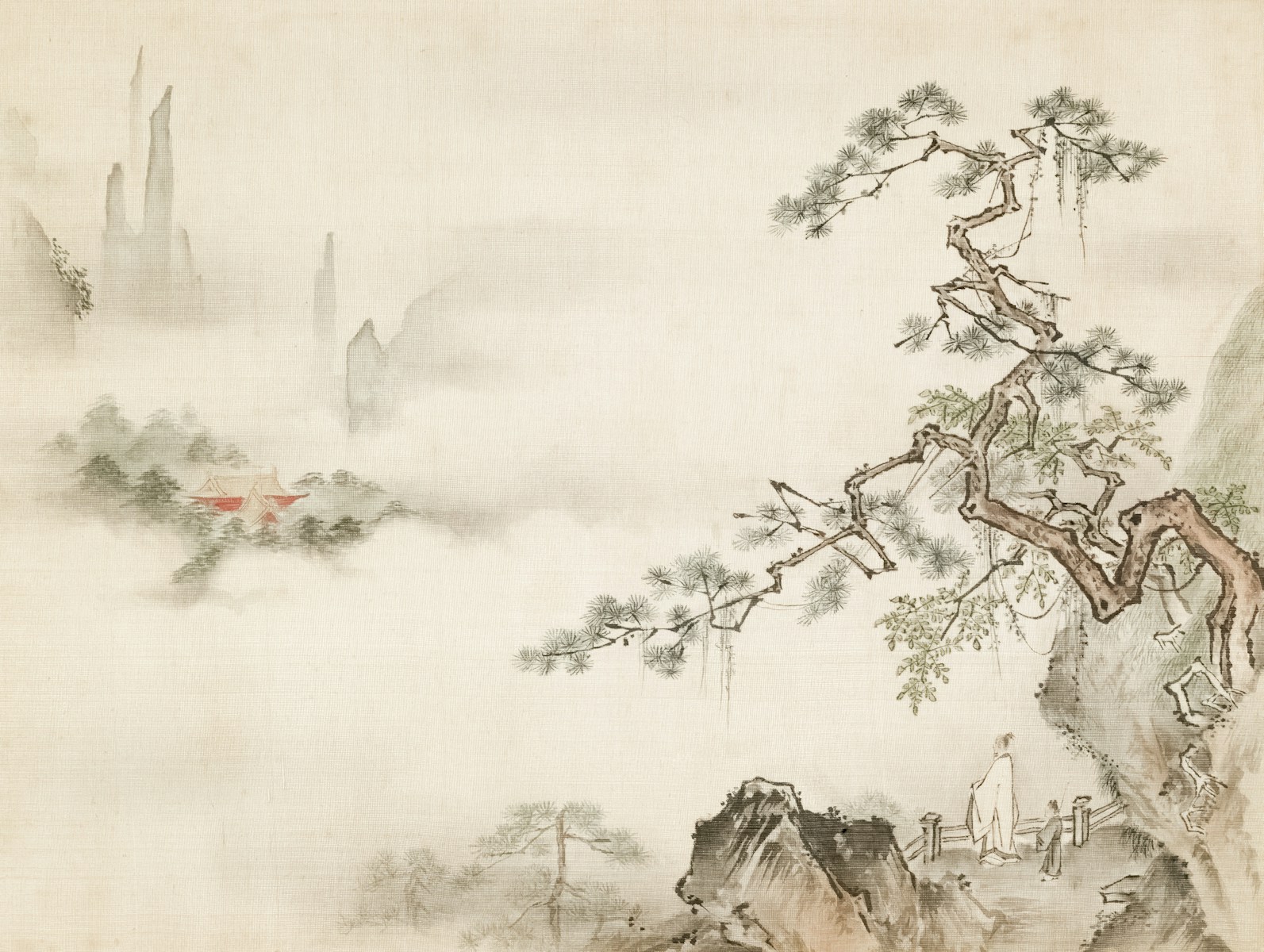
Every character, scene and event of the tale represents the components, characteristics and aspirations of a candidate, who had become stuck on the spiritual path.
The main hero of Andersen’s tale is the Chinese Emperor who lives in a beautiful, fine porcelain palace. The palace has a far extended garden full of miracles with a forest at the end, which goes right down to the seaside.
The Chinese Emperor, living in splendid circumstances, is in a higher sense representing the spiritually oriented ego of the earthly personality, the ’spiritual’ ego. However subtle his egocentrism may be (porcelain palace), his spiritual grade is only a facade.
Every character, scene and event of the tale represents the components, characteristics and aspirations of a candidate, who has become stuck on the spiritual path. In the forest behind the emperor’s garden (in the subconscious) lives a sweet-sounding nightingale. This nightingale is the immortal soul hidden within the candidate’s being. The emperor doesn’t know this bird, he has only read about it in a book – the spiritual ego has only a secondhand knowledge. He calls for his Marshal to get this bird for him, but nobody knows about it in the palace. The Marshal starts to question the truth written in the book:
’Your Imperial Majesty could never imagine the things people write; all manner of inventions, and something which is called the Black Art.’
’But the book in which I read this’, said the Emperor, ‘was sent to me by the high and mighty Emperor of Japan, so it cannot be an untruth. I will hear the Nightingale! It must be here to-night. It has my most exalted favour, and if it does not come, the whole court shall have its stomachs stamped upon, when it has dined!’
The Marshal and the courtiers are the components and sustainer of the lower self-consciousness. The Marshal unintentionally touches upon the essence of the Japanese Emperor, who plays here the role of the tempter. As a Lucifer* he stirs up the “spiritual” desire for acquisition and possession of the lower self with his presence. The statement of the book is true, but the intention is hypocritical: to increase the egoism.
At last they find a poor little kitchen-girl in the palace, who carries leftover food to her sick mother through the forest every day. She says:
’… I hear the Nightingale sing. The tears come in my eyes with it: it feels as if my mother was kissing me.’
The natural, unselfish aspect of the earthly personality is able to lead the selfish forces of the ’spiritual’ ego (the gaudy group of courtiers) to the immortal soul lying in the depth of the soul.
‘That’s it,’ said the little girl. ‘Hark! hark! And there it sits!’ And she pointed to a little grey bird up among the branches. ‘Is it possible?’ said the Marshal. ‘I could never have imagined it would be like that! And how very shabby it looks! It must certainly have lost its colour at the sight of so many distinguished persons in its vicinity.’
The Marshal’s consideration paints a (clinical) picture of the nature of the spiritual ego.
At their request, the nightingale accompanies them to the emperor’s palace, where they prepare to listen to the song of the immortal soul among festive appearances.
‘And the Nightingale sang so beautifully that tears came into the Emperor’s eyes; the tears ran down his cheeks, and then the Nightingale sang yet more delightfully, so that it went straight to his heart; and the Emperor was greatly pleased, and said that the Nightingale should have his golden slipper to wear on its neck. But the Nightingale thanked him and said…’
The emperor wants to award the nightingale with a merit, but it rejects him:
‘I have seen tears in the Emperor’s eyes; that is to me the richest of treasures. An Emperor’s tears have a marvellous power. God knows I am well paid.’
The nightingale is kept in the palace. It is kept in a cage and only let out at night, where a string tied to one of its legs keeps it in captivity. The immortal soul revealed itself to the spiritual ego, but he put it to the service of his selfish goals. Yet – as the emperor’s tears testify – a crack opened in the crusty wall of the ego due to the wake of the pure vibrating soul.
The opposing force – the Japanese Emperor – cannot let this happen: he tempts the Chinese Emperor with another gift. This time not as Lucifer, but as Ahriman**, since he influences, creates a deceitful illusion through the cool, materialistic world of thought and technology. The gift is a masterful replica of the real nightingale: a wind-up mechanical bird, incrusted with precious stones. The spring-driven mechanism – although it could only play a one single song – ‘made as great a success as the real one, and was, besides, far prettier to look at; it glittered like a bracelet or a brooch. Three-and-thirty times over did it sing the self-same melody, and yet it was not tired. The people would have liked to hear it over again, but the Emperor said that now the live Nightingale should sing a little – but where was it? Nobody had noticed that it had flown out of the open window, away to its own green wood.’
The bandmaster – in the spirit of Ahriman – ‘praised the bird in the highest terms, and assured them that it was superior to the real Nightingale, not only as regards the plumage and the many beautiful diamonds, but also internally. (…) But the poor fisherman, who had heard the real Nightingale’ had the following opinion about the fake bird: ‘It sings pretty enough, and it’s like it too; but there’s something wanting, I don’t know what!’ The spiritually inspired aspect of the personality senses what is missing: the soul. The mechanical bird is only seemingly tireless, because suddenly ‘something went “snap” inside the bird. Whirr-rr! All the wheels whizzed round, and the music stopped.’ The bird fell silent. The earthly consciousness fails, it reaches the limits.
Years later, the Chinese Emperor became terminally ill and ‘was hardly able to draw his breath; it seemed as if something was sitting on his chest. He opened his eyes, and then he saw that it was Death, who was sitting on his breast (…) in the folds of the great velvet bed curtains, strange faces pushed themselves out, some quite horrible, others divinely kind. There were all the Emperor’s good and evil deeds, looking at him now…’ The emperor begged for music, for a consoling song, but the spring-driven bird was silent.
‘At that instant there was heard, close by the window, the most lovely song. It was the little live Nightingale that was sitting on the branch outside. It had heard of its Emperor’s need, and so had come to sing to him of comfort and hope…’ Death, moved to tears by the singing, withdrew ‘and the Emperor fell into a sweet sleep, a sleep that was kind and healing.’ Next morning ‘the attendants came in to see their dead Emperor, and – well, there stood they, and the Emperor said: »Good morning!«’
The Emperor’s deadly illness refers to the breakdown of the spiritual ego in the being of the candidate who attains true self-knowledge. In the pure vibrational sphere of the Soul, the ego retreats into the background, and the miracle of self-surrender takes place.
___________________
* Lucifer: the ruler of a group of hindering, tempting spirits. This counterforce strives for people to reach above their head, to phantasise, to become bigots and dreamers, passive followers of authorities, instead of mature, autonomous spirits. It can turn to enthusiastic adorations and emotions and passions heightened to the extreme. People under this influence may think they follow the spiritual path, but it is based on a selfish desire.
** Ahriman: the leader of another group of obstructive, tempting spirits. They drive people deep into matter. Nationalism, literalism, mechanism, narrow-mindedness are some of the characteristics of people under this influence. Earthly intelligence and logical thinking are overdeveloped and science and technology are seen as tools to create an ideal world. True, eternal values are replaced by false ones.
You can read more about counterforces (“demonic” beings) in the books of Rudolf Steiner, who founded the spiritual movement of anthroposophy.
_______
English source of the quoted tale: https://gutenberg.ca/ebooks/andersen-nightingale/andersen-nightingale-00-h.html