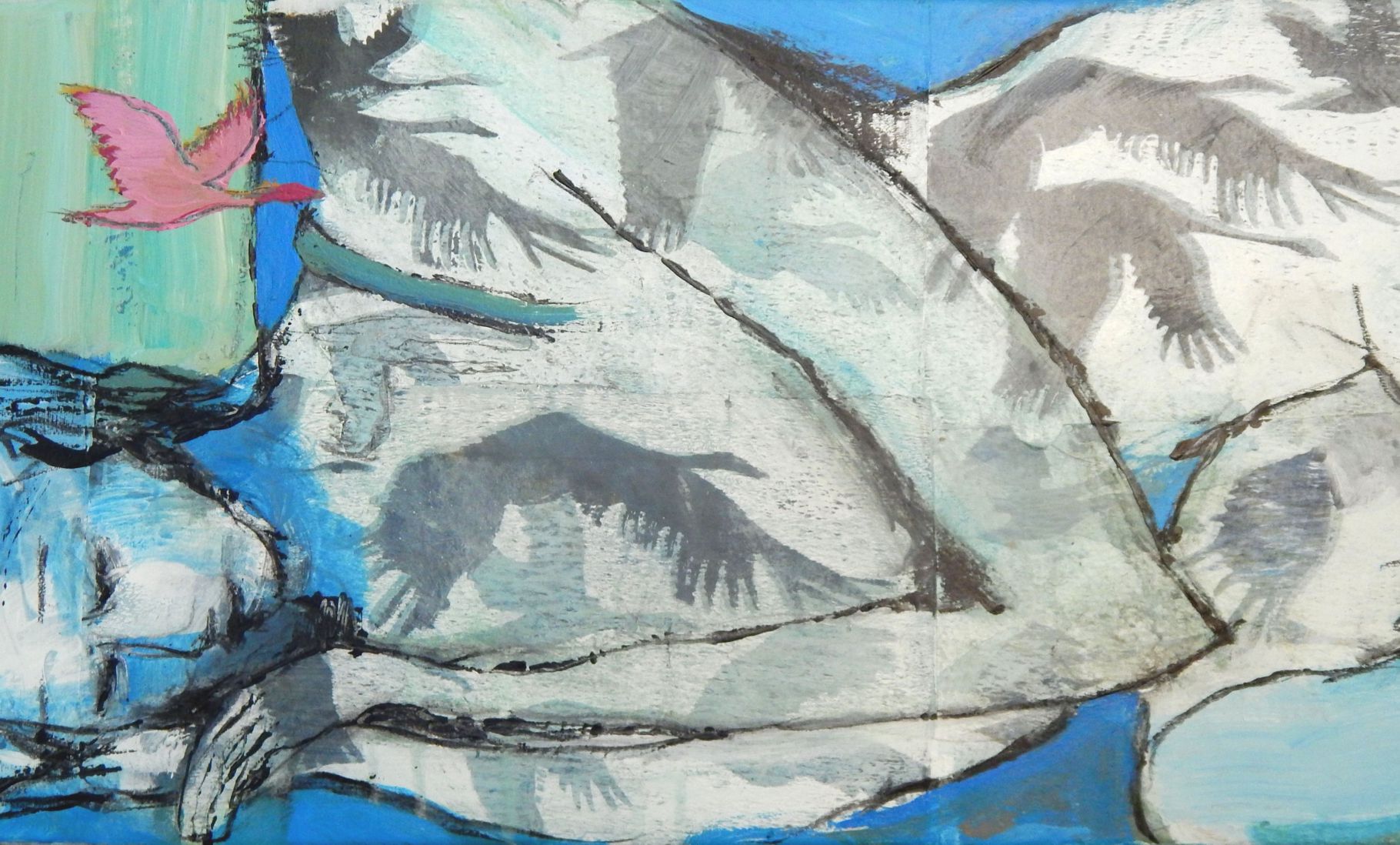
A person in whom Tao lives, knows of the unity of all things. He allows life to wash over him; his heart giving it space.
The ancient Taoist sages made a clear distinction between the everyday consciousness of a person, and the consciousness that is imbued with Tao. They had a simple, but very striking image for this:
A crane flies over a pond. For an instant, it is completely reflected in all its glory in the water.
This describes a very special state of the heart. The Taoists assumed that the ordinary person is not occupied by his ‘centre’, his heart. This means that his heart is not free for the working of Tao. The heart is filled with desires, goals, habits and reactions.
However, if a person’s heart is free, that is, an open, receptive centre in which no volition takes place, the life situation present in the moment can be reflected in Tao. This can in principle, happen in a moment of inner contemplation or selfless devotion to Tao. Personal desires and wishes stand aside and leave space for a much greater efficacy. The crane is then fully reflected in the pond.
One can interpret this image as the crane standing for all of life, for its unity in Tao. We can see it clearly as the whole diversity of a situation with its problems, relationships and interdependences merging into a single perception, into a single impression in the stillness of the heart. The incomplete has been reflected in Tao, it has been made recognisable by Tao, it has been absorbed into Tao. Thus, Tao was brought into effective activity. New thoughts and feelings may have arisen; a solution may have suddenly appeared in a seemingly hopeless situation; a book or a passage may have given us a decisive clue, or an unexpected encounter may have taken place. It can also be that an unexpected strength or cheerfulness has been raised to meet and accept a fateful situation as it is.
Normally, in a situation, be it difficult or pleasant, a person generally reacts by trying to do something with it. He wants to shape, change or classify it according to his ideas and will. Most of the time, he wants to rid himself of something, or hold on to something.
The person in whom Tao works, on the other hand, initially does nothing. He stands in Wu Wei, he practises non-doing. He does not intervene at the level of the ‘ten thousand things’, as Lao Tzu calls it. He does not want to catch the bird, drive it away, or run after it with a mirror or a camera. Rather, he leaves the ‘crane free’ and does not make any judgements about any aspect of its behaviour. He removes his own will completely from the situation and allows what is happening, to come to pass.
Such a person takes nothing away and adds nothing. He knows about the unity in Tao. Within himself, he experiences that the perceived fragmented life is in fact a unity. He lets the situation take hold of him as fully and completely as possible, and in his heart, he gives it space to be whole in Tao. In doing so, he allows the deep yearning for the healing connection with Tao to flow into his experienced reality.
This attitude of letting things happen, which is based on the willingness not to resist the course of things, is expressed in Chinese literature by another image: the pine and the willow in the snow. The pine branch is rigid and breaks under the weight, while the willow branch yields to the weight allowing the snow to slide off. The pine represents selfish, unbending consciousness, which works with resistance and struggle. The willow, on the other hand, yields and adapts flexively. It represents the Tao person, who looks at himself and his life as neutrally and objectively as possible. He allows things to unfold and reveal themselves from their inner essence.
He accepts apparent defeats just as much as successes. Because he knows that the two poles belong together. Yin and yang are mutually dependent. Since he knows that he is connected to the unity of Tao, he lives the joy of inner freedom – whatever may happen in outer life.
However, this inner action through ‘non-intervention’ does not necessarily feel sublime or indestructible. Often, it is precisely in this situation that fears, grief, anger and one’s own inadequacy become tangible. But it is especially in feeling powerlessness, and in the recognition of one’s own insignificance, that the surrender to the wisdom and power of Tao can take place. Now the powers of Tao can flow. A shift of the inner centre of action from the ego to Tao takes place.
The will and the intelligence of Tao allow the possible solution to shine. And not only that. In the heart of the person in whom Tao is at work, things reconnect with their very own inner source. The impulse for a deep inner transformation can become effective. That is why the Taoists in ancient China were known for being particularly cheerful and serene. They did not take themselves too seriously, they let go of themselves and their attachments.
Wu-Wei does not mean that you just sit back and think that Tao will take care of every situation. Of course, the ‘world of ten thousand things’ also requires an external action. However, it is aligned with a higher meaning of life, with the impulses of Tao. It is the art of being in the right place, at the right moment, to do the right thing. This cannot be willed or forced. Rather, it simply happens when a person is in ’movement’ with the free centre.
Tao, as the creator of all life, together with the perceptible life situation, touch each other. The unfathomable depth of being, the creator, the origin, encounters the creation, the manifestation in the human heart. A merging takes place, an awakening to each other. The meaning shines through; strong transformative and evolutionary impulses are triggered, which are significant for the individual as well as for humanity and nature as a whole.
Our everyday consciousness is like a pond full of restless, turbulent water. It can only reflect the crane in a fragmented way, as ‘ten thousand things’. Here we find no peace, no deeper understanding of interrelations, no unity.
The path to unity is the path of the heart. To free our occupied centre for this path means being truly human.
‘Create emptiness to the highest degree!
Maintain stillness to the fullest extent!
Then may all things arise simultaneously.
I watch how they turn.
Things in their multitude,
each one returns to its root.
Returning to the root means stillness.’Lao Tzu – Tao Te King, chapter 16