Writing about Kafka is always a bit personal for a Czech lawyer. The ombudsman, who monitors the legality of state administration, refers to Kafka more than once.
More than once you feel Kafkaesque – or Don Quixote-esque – when you oppose state measures and feel like you’re tilting at windmills. Inevitably, you feel the need for a change, for distance from everything.
But how can you do that? Aren’t you in the middle of a river whose current keeps sweeping you along? You could … step onto the bank and observe and study things from there in peace, to describe them with a sober eye, writing the oppressive feelings from your soul…
Franz Kafka was a lawyer in an insurance company. What is an insurance claim? Something has happened that you were worried about. You have paid money for this event, paid monthly insurance premiums. You have made an agreement with your anxiety. Certain events should not happen. The insurance is supposed to help you break out of the causal cycle of cause and effect.
The Kafkaesque world
Franz Kafka describes the underlying mechanisms of bourgeois life: social roles, the judicial system, the legal system. His main characters find themselves in situations of exaggerated absurdity that reveal the senselessness of things, the hopelessness of life in our matrix. Kafka’s stories have no happy ending; they leave the reader in a sphere of uncertainty.
The world we live in is relative. All its values are relative, all its truths, all justice. We can get used to this, but ultimately we cannot identify with it. Sometimes situations come to a head – and we experience ourselves as strangers, outsiders.
If you read Kafka from a psychological perspective, you can ask yourself: is what he describes really our reality, does it correspond to the inner realities of our world? For example, the situation that we are somewhere in our pyjamas, like K. In the novel The Castle, we stand before the teacher, incapable and prejudiced.
In the novels The Castle and The Trial[1], Kafka evokes a feeling of being oppressed. The boundary between the private and the public dissolves.[2] Inner processes – intentions, feelings – are transferred to the public sphere. Guilt and condemnation weigh on the main character. Where do they come from? Are they evoked by the inner self, which is deprived of freedom? In the spaces of the subconscious – aren’t fear and guilt stored there, isn’t the punishing God of the Old Testament still at work? Thoughts and feelings of this kind arise. We ponder them, scrutinise them – and if it is good, we take away some of the dominating power of what oppresses us from the depths. The mechanisms of the subconscious are connected with our life in the relative world, with the imperfection of our existence. What can one expect from a surveyor (the main character in The Castle) who has the task of measuring the earth, i.e. taking care of the earthly measure? Through strange circumstances, however, Kafka has him become a schoolmaster in the “school of life”.
In the novel The Trial, Josef K. reaches a point where he realises that he has to help himself; he comes to a self-confrontation. The justice system, an automatic apparatus, a dehumanised mechanism, turns Josef K. into a stranger. Experiencing the “naked” situation of existence means reaching the point of self-confrontation. From here, the next step can be taken, the step towards the “human being within us”.
In his interpretation of the process, Lukas van den Berge writes that “the law is only accessible to those who are completely liberated, fully responsible and autonomous“[3]. It is necessary to free oneself inwardly from authority and all manifestations of power.
Law in our world has to do with power and violence, it is associated with coercion. Legal norms are abstract, regulate the average, the norm-ale. They have a tendency to reduce the human to this. Norms are a mirror of life, they are necessities in the relative world. However, if we become inwardly autonomous, then we free ourselves – inwardly – from the influences of power and authority. We find right and justice on a different level, the spiritual level.
How things get their purpose
Everything takes on a purpose when we, driven by circumstances, experience ourselves as strangers on earth and, following an inner longing, turn to the divine-spiritual. The way out and the purpose of things light up in the soul, which opens itself to the spirit. The labyrinth of hopeless imprisonment, the oppressive and condemning feelings of guilt, the cycles of growing meaninglessness – paradoxically, they do have a purpose.
For at the point of greatest despair, cognition emerges, cognition of the imprisonment of our higher soul aspect in the animality of the body. For a long time we have identified with our physical existence. Now a break occurs. And with it comes the deep feeling of being a stranger on earth.
The way out lies in this feeling alone. For it makes us seek the purpose that underlies our existence. We come into contact with our transcendent, perhaps heavenly, spiritual, supernatural essence.
Being a stranger on the material earth, in the material body, means that our home is outside of all this, in a higher vibrating sphere, in the land of the transcendent Logos, in the divine universe.
Towards the end of his life, Franz Kafka professed Hasidism and also took practical life measures such as vegetarianism, abstinence from alcohol, coffee, tea and chocolate in order to realise his spiritual being more easily. It may seem that in his writings he only exposes senselessness and masterfully describes emptiness. But in doing so, he opens the door to existential questions.
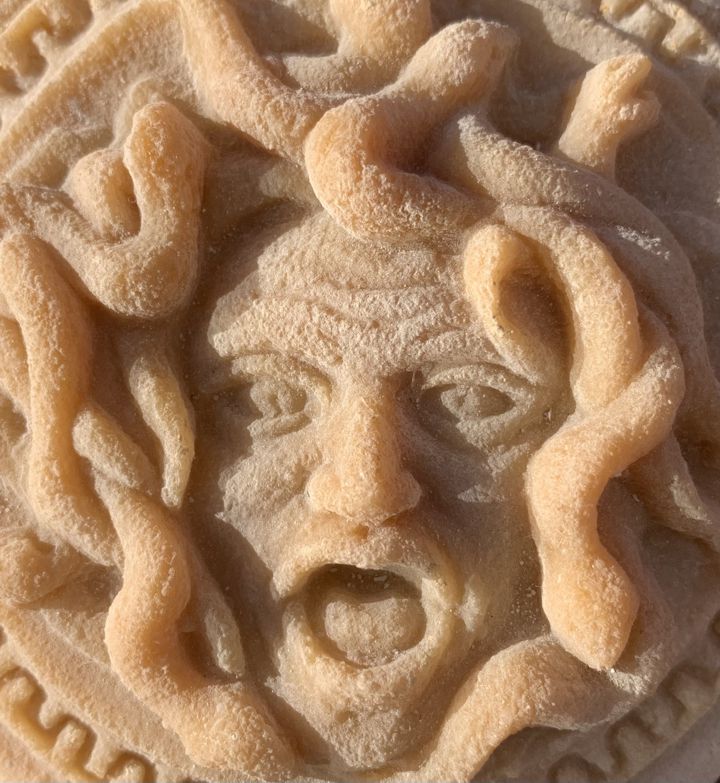
Hasidism is a Jewish pietism with a characteristic piety. An absolute attachment to God gives rise to joy in the little things of everyday life; the presence of God, the Shechinah, permeates the whole world. That was the direction Kafka took. In his novels and stories, he exposes the system of alienation, he turns his gaze to the Medusa, but he does not look her directly in the eye, does not face her with the pride and arrogance of the ego, but recognises in humility and sincerity that it is “so”. And he writes it down. It is not yet the whole truth, but it is a step on the path to it, a door in its direction. Truth is something that, as Ludwig Wittgenstein says, “shows itself”. The mystical, the mystery cannot be put into words.
We can ask ourselves: do we, living in the growth curves of today’s civilisation, experience ourselves in a Kafkaesque alienation? Recognising this would be the first half of the journey. The citizen Karel K. feels lonely in shallow relationships. It is as if he is naively fleeing from himself. But then he finds himself in a situation where he has to defend himself.
Now comes the other half of the journey, the unspoken half, about which one can only remain silent, as Wittgenstein says: the mystery. What first reveals itself is: our being, disintegrated, analysed, divided, alone, with a dead God, alienated, meaningless. If it is recognised as such, the opportunity to become whole arises, the opportunity for unification, for understanding, respect, recognition, meaningfulness. The higher order draws closer, it wants to be discovered and with it the purpose of the long separation from it. This purpose only lights up after living through separation and meaninglessness. And when this happens, we must learn to integrate it into our lives.
Hesitant steps
We experience a great deal of pleasure in separation and isolation, even if we suffer under many circumstances at the same time. Even “at the cape of despair”, as an outcast “on the edge of the world”, we work on an atmosphere for our existence: pessimistic, poetic, intellectual…
After a while, however, we can no longer stand living with ourselves. The question of meaning haunts us. In the distress of loneliness, we start to communicate and ask for help. We take frantic steps towards other people – and talk about the weather so that we at least have contact and learn to get along with others and respect them. We try to reduce the resentment that has grown from alienation, pay attention to everyday things, try to distract ourselves from introspection.
But we have become strangers and remain so. Loneliness no longer leaves us. We feel compelled to confront our ego. But its edges become sharper. How can we succeed in dissolving the ego into something higher? The dynamic of the spirit that hovers over the waters can now take hold of us. We can allow ourselves to be “baptised” by it, we can allow its flashes of fire to enter us – as far as we can stand it. Our view of life continues to change. Things that are clearly meaningless suddenly take on a purpose that we previously had no idea existed. And the idea that our souls have fallen out of God’s world is also shown in a new light. Truth works its way into us, we become more and more animated by the spirit, we become “alive”. We realise how much we are connected to the whole of creation. The time of alienation and separation turns into a time of union and discovery.
And what comes next?
The guardians of the galaxies tell stories for the divine sons who do not yet remember. We receive impulses from them, far-reaching, going beyond words.
Everything rises within us once more, one last mail, before it enters the substances of wisdom, the heavenly “body” that knows no boundaries.
We were strangers and cross the border into our homeland.
In deep inner crisis we have transcended good and evil and overcome duality. Not through asceticism or arrogance, but in humility, longing and the expectation of the divine. It was a state of strange neutrality, in which one does not wish to attract or repel anything. The longing for the divine world order led to an uprooting in the material world.
And there was the tussle with the ego, which somehow managed to persist and play its game. Ultimately, it led us to full maturity, so it had its purpose. But when the lightning from above increases and opens up the vertical path further, the ego loses its meaning. The horizontal direction in which it aims loses its grip.
The search for purpose in the horizontal ceased. The inner senses opened wide and unconditionally, observing everything, living in everything, as it were. This had become possible because the living spirit filled the consciousness and the inner spaces. A certain lightness of being came in the midst of the everyday heaviness.
The path to the divine-spiritual became light-footed. How easy it was to take responsibility for one’s own life once it had been handed over to the spirit! It was important to live according to the instructions of the spirit. They were concretisations of an uncertain nothingness. By allowing them to emerge, we begin to understand.
How did we even know that there was truth in our earthly life? By living in the material, imperfect and in many respects untrue world – and becoming strangers in it, like Franz Kafka.
[1] Kafka wrote “The Trial” in German. In the first edition of the Dutch translation by Lukas van den Berge, the English term “Process” was used, expressing a gradual development. Later editions used the term “Prozess”, which refers more to the final judgement, or to condemnation and guilt when personal responsibility for one’s life is not consciously accepted.
[2] Here I present thoughts from contemporary Dutch legal philosopher Lukas van den Berge, who gave a lecture on Law and Responsibility: Kafka in the Digital Age at the Legal Ethics Conference (ILEC) in Amsterdam on 19 July 2024, on which he collaborated with Jeanne Gaakeer.
[3] Ibid, note from Van den Berge’s presentation.